









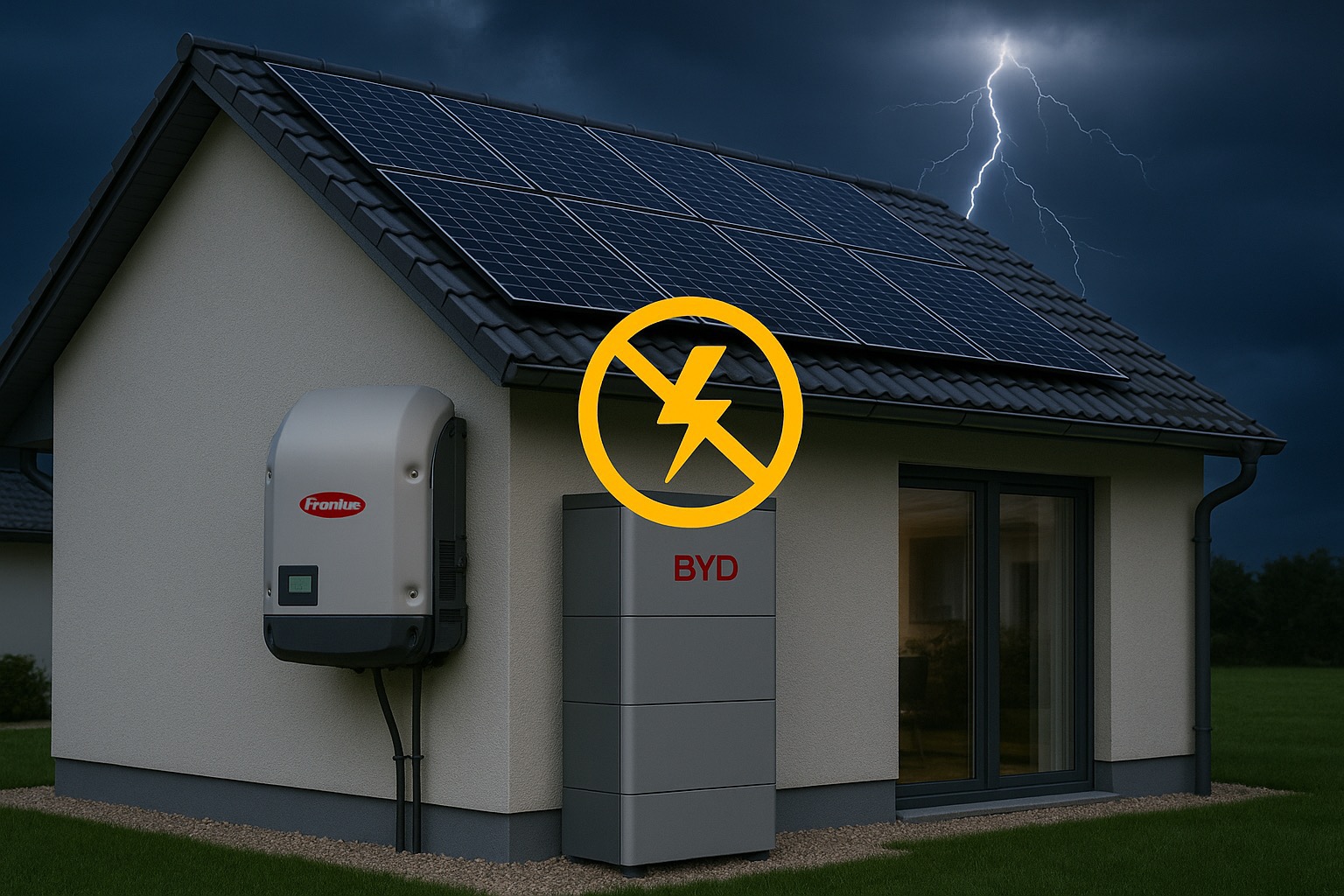
If the grid fails in winter, the inverter alone does not decide whether the lights in the house will stay on. The decisive factor is a small switching device in the meter box, which is either operated manually or switches automatically. This article shows which of the two variants suits your household.
A power outage lasting several hours in the valley is enough to make the difference noticeable: With Fronius emergency power, the refrigerator, heating pump, and router continue to run; without it, the PV system stands still despite the sun. Since a grid-connected inverter switches off for safety reasons in the event of a power outage, a separate solution is required. Fronius solves this with a modular system of three stages, from a single circuit to supplying the entire house. For the large solution, the actual question then arises whether a manual Backup Switch is sufficient or an automatic Backup Controller is more sensible. We at PV-24 regularly advise on this decision and summarize here what is technically behind it.
Three stages of emergency power supply with Fronius
Because Fronius emergency power is modular, the system grows with demand. For some households, a single protected socket is sufficient; others want to notice a blackout as little as possible. Which stage is sensible depends less on the inverter than on which devices really need to run in an emergency.
The three expansion stages build on each other. A smaller solution therefore does not exclude later expansion to full Fronius emergency power.
PV Point as single-phase basic supply
Every GEN24, whether with or without Plus, already includes the PV Point. In the event of a power outage, it supplies a single-phase output with up to 3,000 VA continuous power.
A Fronius emergency power socket or a separately fused circuit is connected to it; the socket itself is not included in the scope of delivery. For refrigerators, routers, chargers, and a few lamps, this is sufficient in many cases.
PV Point Comfort for parallel operation
The PV Point Comfort retrofit board is located in the inverter’s connection area and keeps its circuit energized even during normal grid operation. The Fronius emergency power circuit thus serves not only for exceptional cases but can also be used normally in everyday life.
To protect the circuit, Fronius recommends a line protection of 13 A and a type A RCD with 30 mA.
Full Backup for the entire house
With Full Backup, a switching device disconnects the house grid from the public grid, after which the inverter takes over all circuits. As soon as the house grid is disconnected, single- and three-phase consumers continue to run, and with enough sun, the system simultaneously charges the battery.
The Fronius emergency power supply reaches its full expansion stage here. However, this stage is not feasible without a battery and without a Backup Switch or Backup Controller.
Which inverters support Fronius emergency power
Basically, every current inverter of the GEN24 family offers a form of Fronius emergency power, but the scope differs significantly. All devices have the PV Point on board. Full Backup is reserved for the battery-capable Plus models, and even there it does not cover every power class.
Where is the most common stumbling block? Usually with small systems. Whether a Fronius Symo GEN24 provides emergency power for all three phases depends on the power class. Devices 3.0 to 5.0 Plus do not support Full Backup and are limited to the PV Point. Real three-phase current in emergency operation is only generated by the Symo GEN24 from 6.0 Plus and the Verto Plus series.
| Inverter | Full Backup | Emergency operation in the house |
|---|---|---|
| Primo GEN24 and Symo GEN24 without Plus | no | single-phase via the PV Point |
| Primo GEN24 Plus | yes | single-phase |
| Symo GEN24 3.0 to 5.0 Plus | no | single-phase via the PV Point |
| Symo GEN24 6.0 to 10.0 Plus | yes | three-phase, up to 3,680 VA per phase continuously |
| Symo GEN24 6.0 to 12.0 Plus SC | yes | three-phase, up to 4,133 VA per phase continuously |
| Verto Plus 15.0 to 20.0 | yes | three-phase, up to 7,300 VA per phase continuously |
| Verto Plus 25.0 to 33.3 | yes | three-phase, up to 11,100 VA per phase continuously |
The values are taken from the Fronius Backup Power Solution Sheet (as of September 2026). Storage-capable devices from various manufacturers can be found in our category Hybrid Inverters.
What the “Plus” in GEN24 means
The “Plus” refers to the battery interface. Only these devices can charge and discharge a high-voltage storage system. Therefore, for the Fronius GEN24 Plus to provide emergency power even at night, a storage system must be connected. Devices with the “SC” suffix reportedly deliver slightly more power per phase in emergency operation, according to the datasheet.
Backup Switch or Backup Controller in direct comparison
Both devices perform the same task. They disconnect the house from the public grid in the event of a power outage, allowing the inverter to safely build its own island grid. Whether a Fronius Backup Controller or Backup Switch is a better fit depends on a simple question: Who will flip the switch in an emergency?
Both are mounted space-savingly in the control cabinet. This means no external transfer box is required for Fronius emergency power.
Manual switching with the Backup Switch
The Backup Switch is a three-way switch for up to 63 A. If the grid fails, a resident switches it to emergency operation and back again when the grid returns.
Fronius offers it as 1P/3P-63A with three-pole disconnection and as 1PN/3PN-63A with all-pole disconnection. For houses where someone is almost always on-site in an emergency, this is the more cost-effective form of Fronius emergency power for the entire house.
Automatic switching with the Backup Controller
The Backup Controller detects the power outage itself, switches to emergency operation, and returns to normal operation when the grid returns. This means Fronius emergency power will still activate even if no one is home. This often makes the difference, especially for heat pumps, freezers, or home offices.
The device is designed for 35 A and, according to Fronius, for inverters up to a maximum of 20 kW. We carry the Fronius Backup Controller in the three-pole version in our range; the all-pole variant is designated 3PN-35A.

Matthias Schiestl and his team are always ready to help you reliably and quickly with any questions and with how you can use the devices reliably and efficiently in your everyday life. » learn more about us
+43 676 88731200 9 AM - 12 PM weekdays info@pv-24.at
Three-pole or all-pole disconnection
The abbreviations P and PN describe what is disconnected during switching. Three-pole devices only disconnect the three live conductors, while all-pole devices also disconnect the neutral conductor. In Austria, the three-pole version is common; in Germany, all-pole disconnection is mandatory. Your electrician will coordinate with the grid operator before ordering to determine which variant applies to Fronius emergency power at your connection.
| Criterion | Backup Switch | Backup Controller |
|---|---|---|
| Switching | manual via three-way switch | automatic |
| Switch-back on grid return | manually | automatic |
| Maximum current | 63 A | 35 A |
| Suitable inverters | GEN24 Plus and Verto Plus | GEN24 Plus and Verto Plus up to 20 kW |
| Variants | 1P/3P-63A and 1PN/3PN-63A | 3P-35A and 3PN-35A |
| Price level | lower | higher |
| Typical use | Residents mostly at home, tight budget, Verto Plus over 20 kW | Heat pump, home office, frequent absence |
In addition to the two Fronius solutions, there are transfer devices from other providers, which we have summarized in the category Grid Transfer Box.
What Fronius emergency power without a battery can achieve
Fronius emergency power without a battery is possible, but only via the PV Point or the PV Point Comfort. The inverter then feeds the emergency power circuit directly from the modules. The available power fluctuates with every cloud, and a starting compressor can briefly overload the output. The supply ends at sunset.
For full backup, however, Fronius absolutely requires a storage unit. Technically, this is understandable: Only the battery absorbs load peaks and keeps the island grid stable with changing irradiation.
Both variants share one strength, as the system is black-start capable. If the storage unit is empty after a long night, the Fronius GEN24 will still supply emergency power again as soon as enough light falls on the modules in the morning. In parallel, it charges the battery.
The storage unit determines how long the house continues to run
Whether a Fronius storage unit provides emergency power for a few hours or until the next sunrise depends on the usable capacity and the consumption in emergency operation. As soon as we jointly create a list of truly necessary devices during the consultation, the storage question usually clarifies itself faster than with any rule of thumb.
Fronius Reserva and Reserva Pro
The Fronius Reserva serves as an in-house storage unit for Fronius emergency power, available in four sizes with approximately 6 to 16 kWh of usable capacity. For larger systems, the Reserva Pro complements the program with capacities up to 32 kWh.
Since the combinable sizes differ between GEN24 Plus and Verto Plus, it is worth checking the compatibility list before purchasing. Both series use LFP cells and are DC-coupled, meaning the solar power goes into the battery without additional conversion.
BYD Battery-Box with GEN24 Plus
As an alternative to its in-house storage system, Fronius has approved selected types of the BYD Battery-Box Premium from the HVS and HVM series. A Fronius BYD emergency power system functions in an emergency exactly like a pure Fronius system; here, too, a Backup Switch or Backup Controller is required.
Only combine types from the current Fronius approval list; other storage systems cannot be operated with the GEN24 Plus. The modularly stackable BYD HVM is particularly suitable for systems that are to be expanded later.
Roughly estimate capacity for emergencies
The amount of capacity required for Fronius emergency power can be determined by a simple calculation. Typical base loads in emergency operation are approximately in this range:
- Refrigerator and freezer: approximately 1 to 1.5 kWh per day
- Heating and circulation pump: approximately 0.5 to 1 kWh per day
- Router, mobile phone, and laptop: approximately 0.3 to 0.5 kWh per day
- LED lighting in the evening: approximately 0.2 to 0.5 kWh
For one day of basic supply, this roughly adds up to two to three and a half kilowatt-hours. A heat pump, electric stove, or electric car, however, quickly shifts the calculation into the double-digit range.
Where Full Backup reaches its limits
Even a Fronius GEN24 Full Backup is not an uninterruptible power supply. While the device switches over, the lights in the house briefly go out, and computers without their own UPS restart. Most devices are unaffected by this, but a server in a home office would be.
The second limitation of Fronius emergency power is its output. The sum of all consumers must remain below what the modules and battery can jointly supply. Additionally, the output per phase is critical. A instantaneous water heater or a sauna on one phase can overload a Symo GEN24 Plus in emergency operation, even if the total output would theoretically be sufficient.
The Fronius Full Backup also includes a Fronius Smart Meter and the appropriate configuration on the inverter. There, among other things, the frequency of the emergency power grid can be set between 45 and 55 Hz. Planning and commissioning should therefore be handled by an electrician familiar with the system.
Which Fronius emergency power solution suits your household
From many planning discussions about Fronius emergency power, four typical starting situations have emerged. They do not replace an individual design but provide an initial direction:
- Basic protection for a few devices: The integrated PV Point or the PV Point Comfort is sufficient; a battery is optional.
- Small system with Symo GEN24 up to 5.0 Plus: Here, it remains with the PV Point; a Full Backup is not technically provided.
- Primary residence with heat pump, freezer, or home office: Backup Controller plus a sufficiently sized battery so that the switchover works even in your absence.
- Tight budget or Verto Plus over 20 kW: The Backup Switch, provided someone is on-site in an emergency.
If you are unsure which group your household falls into, the inverter’s type plate and your electricity bill for the winter months can help. Both together show which level is technically possible and economically sensible.
Retrofitting, Installation, and Costs
For an existing Fronius inverter to supply emergency power to the entire house, a GEN24 Plus with a battery usually only requires the changeover device and an appointment with an electrician. Replacing the inverter is generally not necessary. Installation into the house network is exclusively the responsibility of a licensed electrical technician; self-installation is not an option here.
To realistically estimate the costs, it is worth looking at the individual items. In terms of price, the Backup Switch is significantly less expensive than the Backup Controller, but both cost only a fraction of the storage. Electrical work in the meter box can account for a noticeable share, especially if circuits need to be re-sorted. An offer for Fronius emergency power should therefore always list the device and installation together.
Our advice for your emergency power planning
The decision can be broken down into three questions. Is a storage unit available or planned? Without it, you will be limited to the PV Point, regardless of the size of the system on the roof. Does the house also need to switch over when no one is home? Then there is no way around the Backup Controller. If a single action is sufficient in an emergency, the Backup Switch saves money while providing the same supply to the house. Ultimately, Fronius emergency power is less a question of equipment and more a question of everyday life.
As a family business from the Zillertal, we would be happy to put together the right combination of inverter, storage, and transfer device with you. You can reach us by phone, WhatsApp, or email; all contact methods can be found under Contact.