




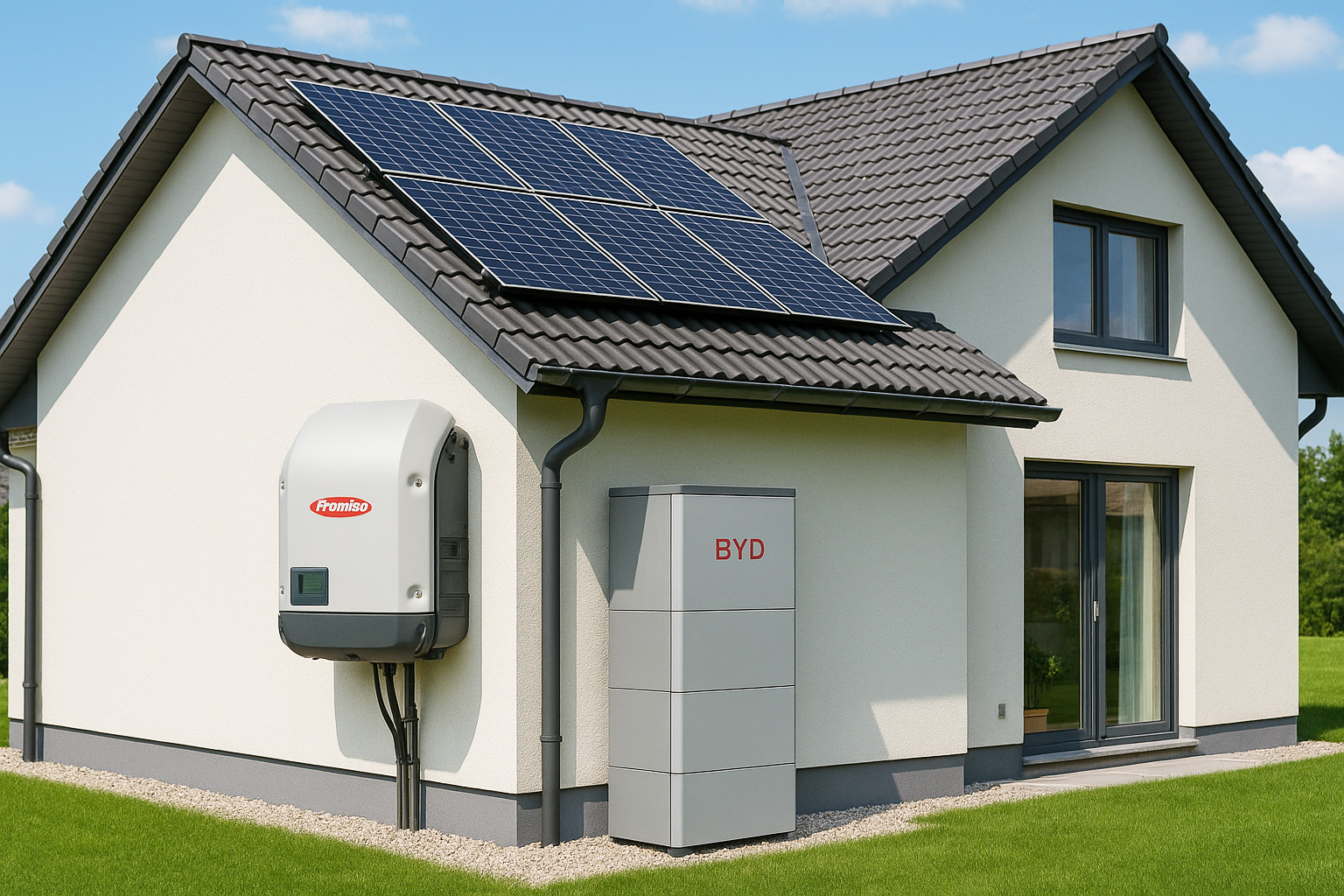
When it comes to combining photovoltaics and storage systems, many questions arise: Fronius or BYD?
Fronius vs. BYD: The perfect symbiosis for photovoltaic systems & solar storage?
In renewable energy from solar power, Fronius and BYD are among the leading manufacturers when it comes to powerful photovoltaic systems and reliable energy storage solutions. But how well do Fronius’ Austrian inverter expertise harmonize with the innovative storage technology of the Chinese giant BYD? In this article, we take a closer look at the interaction of both systems – their strengths, differences, and why they are often considered the “perfect symbiosis” in modern PV systems.
An Introduction to Photovoltaic Systems and Battery Storage
What are photovoltaic systems and what are they used for?
Photovoltaic systems are systems that convert sunlight into electrical energy. They consist of solar modules that capture sunlight and an inverter that converts the generated direct current into alternating current. But why is this important to you?
Imagine you could generate your own electricity. This is not only environmentally friendly but also cost-saving. Many people opt for photovoltaic systems to reduce their energy costs and become more independent from large energy providers.
The Role of Inverters and Battery Storage
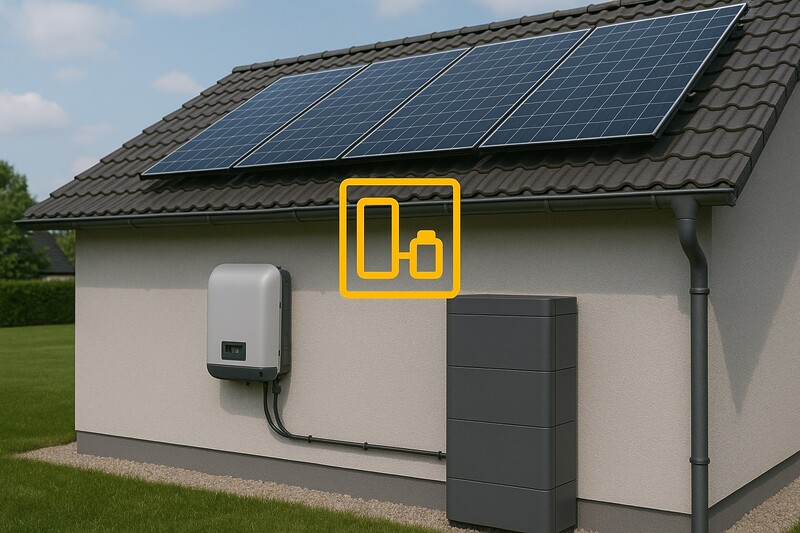
Inverters are the heart of every photovoltaic system. They are responsible for converting solar power into usable electricity for your home. Without them, the generated electricity would not be usable.
Battery storage systems also play a crucial role. They store excess electricity that you generate during the day for use at night or on cloudy days. This allows you to use your own electricity more efficiently and reduce your dependence on the grid.
Overview of Fronius and BYD
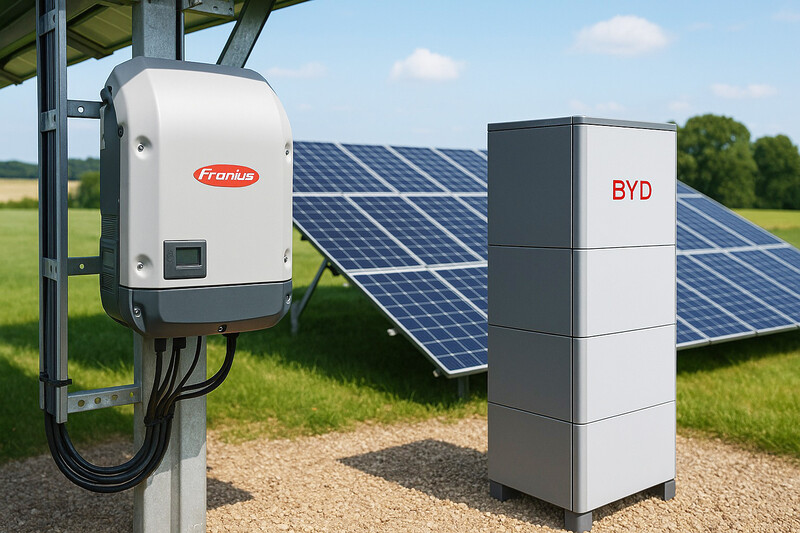
When it comes to inverters and battery storage, Fronius and BYD are two of the most well-known brands on the market. Fronius offers a wide range of inverters, including the Fronius SYMO Gen 24, which offers a power output of 3 kW to 12 kW. What makes Fronius special is the flexibility their devices offer. They allow the use of multiple strings per MPP tracker, which increases efficiency.
No matching products found.
On the other hand, BYD has attracted a lot of attention with its battery storage systems, such as the HVB and HVE. These storage systems offer high capacity and long warranty periods. The HVB can be expanded from 5.94 kWh to up to 29.69 kWh. That’s impressive flexibility!
No matching products found.
Market Developments and Trends in Solar Energy
The demand for solar energy is constantly growing. More and more people are recognizing the benefits of photovoltaic systems. The technology is developing rapidly. New systems are constantly being improved to become more efficient and user-friendly.
One trend you should pay attention to is the integration of smart home technologies. More and more photovoltaic systems are equipped with intelligent control systems that help you optimize your electricity consumption. This means that you can not only generate electricity but also manage it better.
‘The strategy behind photovoltaic systems is simple: generate and store your own electricity.’
In today’s world, where one’s own electricity consumption can be made increasingly efficient, battery storage systems and inverters play a central role. The combination of these technologies allows you to reduce your energy costs and your ecological footprint.
If you are considering investing in a photovoltaic system, it is important to compare the different options. Fronius and BYD offer different advantages, and the choice depends on your individual needs. Inform yourself well before making a decision!
Fronius Symo Gen 24 and BYD Hybrid Inverters in Detail
If you are interested in solar energy, you have probably heard of Fronius and BYD inverters. But what makes these devices so special? Let’s explore the details.
1. Comparison of Compatibility with Battery Storage Systems
Compatibility is crucial. The Fronius Symo Gen 24 inverter works well with the Fronius Reserver storage system. This is practical if you are looking for a unified system. In contrast, the BYD HVE battery is only compatible with BYD’s own hybrid inverters. This can limit your choices.
The BYD HVB battery, on the other hand, is more flexible. It can also be combined with inverters from other manufacturers, such as Kostal and SMA. This gives you more freedom in choosing your system.
2. Different Power Classes
Another important point is the power classes of the inverters. The Fronius Symo Gen 24 offers a power range of 3 to 12 kW. This is a wide range that covers many applications. As the manufacturer states:
‘With a wide power range, Fronius covers an extensive spectrum of applications.’
In comparison, the BYD TH hybrid inverter has a power of 5 to 10 kW. This might be sufficient for smaller applications, but the flexibility of the Fronius is clearly an advantage here.
3. Overview of Advantages and Disadvantages
- Fronius Symo Gen 24:
- Advantages: Wider power range, high compatibility, better emergency power capability.
- Disadvantages: Higher costs compared to some alternatives.
- BYD TH Hybrid Inverter:
- Advantages: More affordable, good warranty periods.
- Disadvantages: Limited compatibility, lower power output.
4. Suitability for Specific Use Cases
Which inverter is suitable for you? If you want to power a larger house or multiple appliances, the Fronius Symo Gen 24 is likely the better choice. The ability to operate with a wide power range is a significant advantage.
For smaller applications or when budget is a concern, the BYD TH hybrid inverter might be the right choice. It offers good performance at a lower price but is limited in flexibility.
Technical Details
Here are some technical details you should consider:
| Inverter | Power | Voltage range |
|---|---|---|
| Fronius Symo Gen 24 | 3 – 12 kW | 80 – 1000 Volts |
| BYD TH Hybrid Inverter | 5 – 10 kW | 160 – 950 Volts |
An inverter must be tailored to the requirements of the solar installation to ensure efficient energy conversion. The choice between Fronius and BYD therefore depends heavily on your individual needs.
Remember that the right decision depends not only on technical specifications but also on long-term use and costs. Inform yourself well before making a choice!
In Depth: Comparing Battery Storage Systems
When it comes to choosing the right battery storage system, there are many factors to consider. Capacity is one of the most important points. It determines how much energy can be stored. But what does that mean for you? A higher capacity allows you to store and use more solar energy when the sun isn’t shining. This can significantly reduce your electricity bill.
1. Different Capacities and Their Significance
The capacity of battery storage systems varies greatly. For example:
- Fronius: Capacities from 6.3 to 15.9 kWh.
- BYD: Flexibly combined systems from 5.94 to 29.69 kWh.
A larger capacity means you can store more energy. This is especially important if you live in an area where the sun doesn’t always shine. It’s like a large water reservoir: the more water you store, the longer you can use it.
2. Battery Capacity Expansion Options
Another important point is the possibility of expanding capacity. You want to ensure that your system can grow with your future needs. BYD offers a flexible solution here. Their systems can be easily expanded from 5.94 kWh up to 29.69 kWh. This gives you the freedom to adapt your system as your energy needs change.
Matthias Schiestl and his team are always ready to help you reliably and quickly with any questions and with how you can use the devices reliably and efficiently in your everyday life. » learn more about us
+43 676 88731200 9 AM - 12 PM weekdays info@pv-24.at
3. Compatibility with other systems
Compatibility is also crucial. You want to ensure that your battery storage works with other devices in your home. The Fronius Reserver Storage is compatible with Fronius hybrid inverters. BYD’s HVE battery, on the other hand, only works with BYD’s own hybrid inverters. This can limit your choices.
However, the BYD HVB battery is highly compatible and can also be combined with other manufacturers such as Kostal and SMA. This gives you more flexibility in choosing your system.
4. Manufacturer warranty periods
The warranty is another important aspect. You want to ensure that your investment is protected. Fronius offers a standard market warranty of 10 years. BYD, on the other hand, offers an extended warranty of 15 years. This gives you more security and shows that the manufacturer has confidence in the quality of its products.
“Choosing the right battery storage can determine the efficiency of the entire solar installation.”
Technical data in comparison
Here are some technical data from both manufacturers:
| Manufacturer | Storage | Capacity |
|---|---|---|
| Fronius | 3.15 kW storage | 6.3 – 15.9 kWh |
| BYD HVB | 2.97 kWh modules | 5.94 – 29.69 kWh |
| BYD HVE | 4 kWh blocks | Minimum capacity 6 kWh, max 22.97 kWh per tower |
The right storage system plays a crucial role in a household’s energy self-sufficiency. It is important to consider all factors before making a decision. Remember that choosing the right system not only affects your electricity bill but also your entire lifestyle. Are you ready to take the next step towards energy independence?

Backup Power Solutions: Who is Ahead?
When it comes to backup power capability, Fronius and BYD are in focus. Both manufacturers offer systems that function reliably in an emergency. But how do they differ? And which system is better for you?
Backup Power Capability of Fronius and BYD
The ability to function in backup power mode is essential for many users. It can be decisive in choosing the system. Fronius relies on a combination of manual and automatic switching. This means that in an emergency, you can quickly switch to the backup power supply. BYD, on the other hand, has a very fast switching time, which is advantageous in critical situations.
Differences in Switching Time
- Fronius: Manual and automatic switching.
- BYD: Fast switching time.
The question here is: What is more important to you? Manual control or lightning-fast switching? If every second counts, BYD might be the better choice. But Fronius offers you more flexibility.
Practical Application in Backup Power Cases
In a backup power situation, practical application is crucial. You want to ensure that your entire household electrical grid can be connected. Fronius makes this possible with the Fronius Backup Box. This is a clear advantage. With BYD, it can be perceived as more cumbersome to get the entire system up and running.
User Experiences
What do users say? Many report on the reliability of the systems. The reliability in emergency power operation is an important selling point. Fronius users appreciate the ease of use and the ability to react quickly in an emergency. BYD users, on the other hand, praise the fast switching time. So there is positive feedback for both systems.
‘In an emergency, every second counts. This is where it becomes clear which product is superior.’
This statement hits the nail on the head. In an emergency, it is important that everything works smoothly. You don’t want to lose time if the power goes out. Therefore, it is important to compare the systems carefully and weigh the pros and cons.
Important considerations for emergency installation
Before you decide on a system, you should consider a few things:
- How quickly must the switchover take place?
- How easy is the installation?
- What warranty periods do the manufacturers offer?
The warranty periods are also an important point. BYD offers a warranty period of 15 years, while Fronius offers 10 years. This could be a decisive factor for you if you value longevity.
In summary, both Fronius and BYD have their strengths. The choice depends on your individual needs. Consider carefully which system suits you best. Because in an emergency, every second counts.
Conclusion: Where is the path of photovoltaic combinations leading?
The world of photovoltaics is dynamic and full of possibilities. The combination of Fronius and BYD shows how complex and technically sophisticated modern solar systems can be. But what are the strengths and weaknesses of these systems? And how do you choose the right system for your needs? Let’s consider these questions together.
Summary of strengths and weaknesses
Let’s start with the strengths. The Fronius Symo Gen 24 inverter offers a wide power range from 3 kW to 12 kW. This is particularly advantageous for different roof sizes and energy requirements. In addition, the emergency power capability ensures that you are not left in the dark even in the event of a power outage. The Fronius Backup Box ensures easy switching between grid and emergency power operation.
On the other hand, BYD, with its HVB and HVE battery storage systems, offers impressive 15-year warranties. This is above market standard and provides you with peace of mind. The flexibility in capacity is also a plus. However, as with any system, there are also weaknesses. BYD’s emergency power supply can be perceived as more cumbersome. Additionally, BYD’s hybrid inverters are only compatible with their own batteries.
Personal Recommendations for Selection
If you are considering installing a photovoltaic system, you should take your personal situation and specific energy needs into account.
‘The decision should always be made individually and tailored to your needs.’
Consider how much energy you need and how much space you have on your roof. If you want a wide power range and a simple emergency power supply, Fronius might be the better choice.
If, however, you value a long warranty and flexible capacities, you should consider BYD. It is important that you try out the different combinations and find out what suits you best.
We would be happy to advise you free of charge before your purchase:
A Look into the Future of Solar Energy
In the solar energy industry, we are only at the beginning of an exciting development. Technologies are evolving rapidly. New innovations and combinations are constantly being brought to market. Remember that the future of solar energy lies not only in technology but also in how we use these technologies.
The combination of Fronius and BYD is just one example of the potential inherent in solar energy. There are many possibilities to explore. Be open to new ideas and developments.