









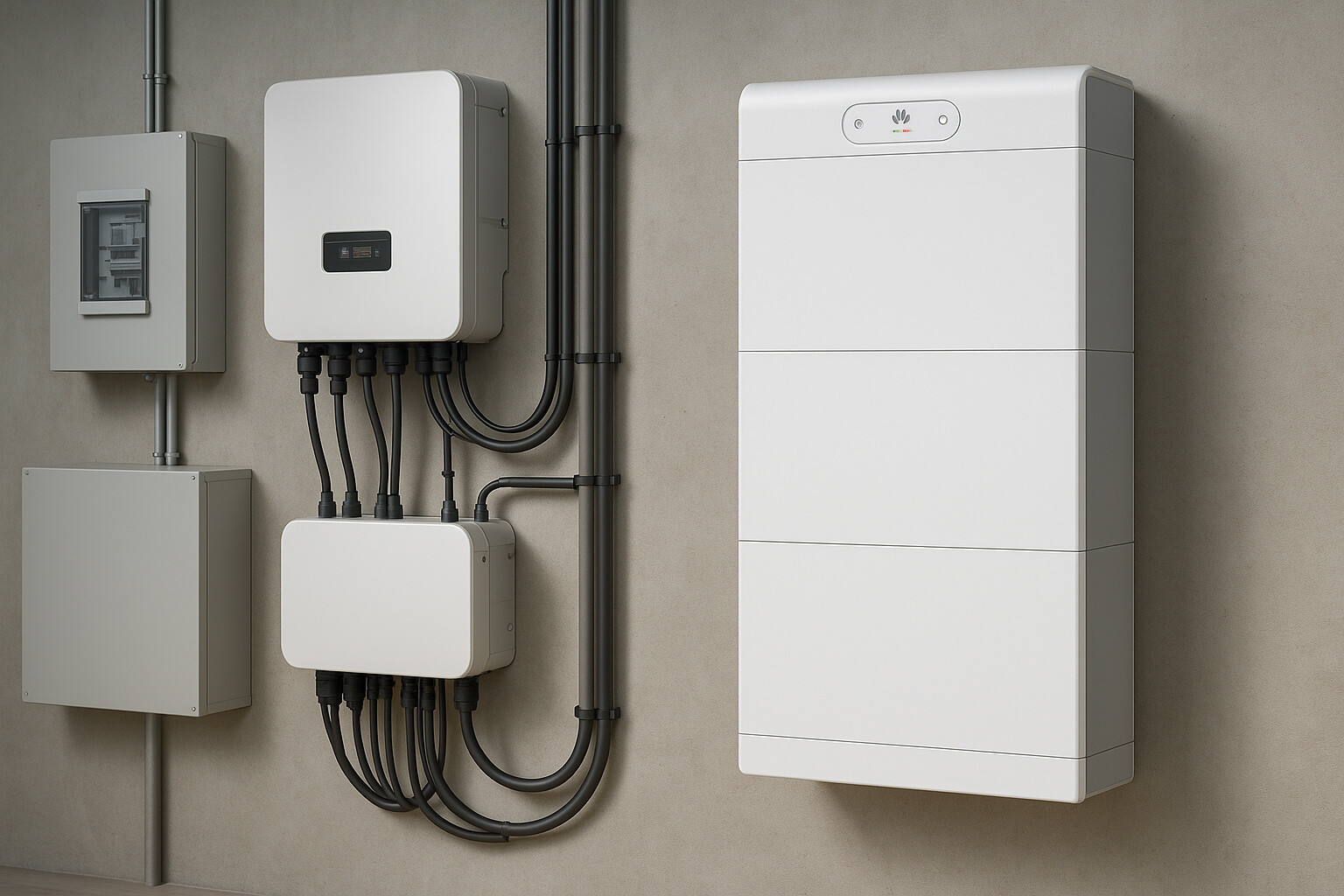
Battery storage systems for photovoltaic installations are becoming increasingly important when it comes to efficiently utilizing self-generated solar power. The LUNA2000-21-S1 storage system is aimed at homeowners who wish to maximize their self-consumption and become more independent from the public power grid. With a usable capacity of up to 21 kWh, the system offers sufficient storage volume for larger households.
This Huawei LUNA2000 review examines the technical characteristics, installation options, and practical experiences with the battery storage system. The modular concept allows for flexible adaptation to different consumption profiles. The central question is whether the system meets the requirements of modern photovoltaic installations and what advantages it offers in everyday use. You will learn what to consider when making a selection and what special features distinguish the S1 model.
What is the Huawei LUNA2000-21-S1?
The LUNA2000-21-S1 represents a modular battery storage system specifically designed for use in private photovoltaic installations. The system is based on proven lithium iron phosphate technology, which is characterized by high cycle stability and thermal stability. As the successor to the S0 model, the S1 generation offers improved performance values and simplified installation.
The structure is modular: each storage unit has 6.9 kWh of usable capacity. By combining up to three modules, you can achieve the maximum single-tower capacity of 20.7 kWh. The storage system can be used for both new installations and for retrofitting existing systems. The compatibility with various inverter generations is particularly interesting.
Huawei LUNA2000 experiences show that the system is suitable for households with different energy needs. Smaller households start with one module, while larger consumers utilize the expansion options. DC coupling allows for direct integration into the photovoltaic system without additional conversion losses.
Technical Data at a Glance
The modular structure of the storage system consists of a base, a power module, and the actual battery modules. Each individual module weighs 68 kg and provides a storage capacity of 6.9 kWh. The charging and discharging power scales with the number of modules: one module achieves 3.5 kW, two modules 7 kW, and three modules 10.5 kW. This increase in power doubles the values of the predecessor S0 model.
➡ Huawei LUNA2000-21-S1 – 21kWh Storage System in the PV-24 Shop
Technical Specifications
| Property | Value |
|---|---|
| Capacity per module | 6.9 kWh |
| Max. capacity per tower | 20.7 kWh (3 modules) |
| Max. total capacity | 82.8 kWh (4 towers) |
| Charge/discharge power (1 module) | 3.5 kW |
| Charge/discharge power (3 modules) | 10.5 kW |
| Weight per module | 68 kg |
| Protection class | IP66 |
| Operating temperature | -20°C to +55°C |
| Battery technology | Lithium iron phosphate (LFP) |
| Warranty | 15 years at 80% capacity |
Up to four battery towers can be connected in parallel, theoretically allowing for a total capacity of over 80 kWh. The IP66 protection class ensures protection against dust and strong jets of water. The operating temperature range extends from -20°C to +55°C. This range is achieved through an integrated heating function that uses excess PV energy for temperature control.
Installation and Assembly
The installation of the storage system is relatively straightforward thanks to its plug-and-play concept. The adjustable base can be leveled from above using adjustable feet to adapt to uneven surfaces. This solution saves time compared to systems where adjustments must be made from the side. A supplied template facilitates pre-drilling the mounting points for the tilt protection.
Installation Steps at a Glance
- Align the base – Leveling from above using adjustable feet
- Pre-drill mounting points – Using the enclosed template
- Stack battery modules – With two people and carrying handles
- Fix modules – Use spring-loaded connecting screws
- Attach wall mounting bracket – Angles and anchor bolts on the topmost module
- Mount power module – Side mounting on the tower
- Lay cables – Control line and power cable through side panels
- Attaching the covers – Working from bottom to top
The battery modules are stacked on top of each other and secured with spring-loaded connecting screws. Four included carrying handles simplify the handling of the heavy modules – nevertheless, a second person is required. The power module is attached to the side of the uppermost battery module.

Expandability and Flexibility
A decisive advantage lies in the possibility of expanding the system throughout its entire lifespan. The intelligent battery management system automatically balances different charge levels between old and new modules. When retrofitting, you do not have to pay attention to whether the existing module is fully charged or what its state of aging is. This flexibility distinguishes the system from many competitors.
Expansion Options
- Timing: Expansion possible at any time – even years after initial installation
- Compatibility: New and old modules work together seamlessly
- Charge level: No equalization necessary before expansion
- Aging: System automatically compensates for different module ages
- Scaling: Continuously expandable from 6.9 kWh to 82.8 kWh
Each battery module has its own management system that handles cell monitoring and control. New and older modules work together harmoniously, even if the latter have already been in operation for several years. Capacity differences are compensated for by intelligent control.
The LUNA2000 experiences prove that this expansion logic works in practice. Households can start with a small configuration and upgrade as demand increases.
➡ Buy Huawei LUNA2000-21-S1 – 21kWh Storage System now
Backup Power Function and Safety
The system supports three-phase backup power with an output of 3.3 kW. The switchover time is only 20 milliseconds – so short that even sensitive devices such as televisions or computers continue to run. This fast reaction time prevents interruptions in the household during power outages. In addition, the storage unit has black start capability: it can reactivate itself with PV energy the next morning after complete discharge.
Five-Stage Safety Concept
- Cell level: Thermally stable LFP technology
- Module level: Continuous monitoring of temperature and voltage
- System Level: Intelligent Battery Management System
- Enclosure Level: IP66 protection against environmental influences
- Emergency Protection: Integrated extinguishing capsule from 180°C internal temperature
The five-stage safety concept comprises multiple layers of protection. The lithium iron phosphate cells used are considered thermally stable and less susceptible to thermal runaway than other lithium technologies. An integrated extinguishing capsule activates at internal temperatures of 180°C and above, preventing fire spread by displacing oxygen.
The Huawei LUNA2000 S1 test shows: The robust design with IP66 protection class allows for use in dusty or humid environments. Tests have proven that the system can stand in 40 cm deep water for up to 72 hours without damage.
Special Features in the Test
The DC coupling between the inverter and the battery storage significantly reduces conversion losses. The direct current from the PV modules flows directly into the storage, without first being converted into alternating current. This direct energy transfer minimizes heat generation in the system and increases overall efficiency. Compared to AC-coupled systems, there is a noticeable efficiency advantage.
Unique Selling Points
| Feature | Advantage | Benefit |
|---|---|---|
| Integrated heating | Operation down to -20°C | Charging possible even at sub-zero temperatures |
| IP66 protection class | Water protection | 72h in 40cm deep water |
| DC coupling | Low conversion losses | Higher overall efficiency |
| 20ms switching time | Uninterruptible operation | Devices continue running during a power outage |
| Black start capable | Independent reactivation | Automatic start via PV energy |
The integrated heating function is a unique selling point. At low outside temperatures, the system uses excess PV energy to keep the battery modules at operating temperature. This is the only way to ensure reliable operation at -20°C.
Matthias Schiestl and his team are always ready to help you reliably and quickly with any questions and with how you can use the devices reliably and efficiently in your everyday life. » learn more about us
+43 676 88731200 9 AM - 12 PM weekdays info@pv-24.at
Huawei LUNA2000 S1 experiences highlight the high-quality workmanship. The design looks modern and blends inconspicuously into technical rooms. The compact design allows it to be installed in the basement, garage, or utility rooms.
Huawei LUNA2000 S1 Practical Experiences
Commissioning is carried out via a wizard in the associated app. After establishing the bus connection between the inverter and the storage unit, the system automatically recognizes the components. Manual configuration steps are limited to basic settings. This significantly simplifies installation and reduces potential sources of error. Automatic detection also works reliably for subsequent expansions.
User Practical Experiences
- Commissioning: App-controlled and completed within minutes
- Daily operation: Fully automatic control without manual intervention
- Self-consumption: Significant increase through intelligent storage use
- Winter operation: Reliable charging even at frosty temperatures
- Noise development: Virtually silent operation in residential environments
- Maintenance: No regular maintenance required
Compatibility with various inverter generations proves to be a practical advantage. Even older models can be retrofitted with the S1 storage system without requiring an inverter replacement. This backward compatibility protects existing investments and enables a gradual modernization of the photovoltaic system.
The Huawei LUNA2000 review shows high reliability in daily operation. The battery management automatically optimizes charging and discharging processes, so manual intervention is not required. The self-consumption rate increases noticeably as surplus solar power is stored and used at a later time.
Warranty and Longevity
The manufacturer grants a 15-year warranty on 80 percent of the original capacity. This warranty performance is above the industry average and signals confidence in product quality. After 15 years of operation, at least four-fifths of the initial storage capacity will still be available to you. This long-term security facilitates the calculation of economic efficiency.
Lifespan in Detail
| Parameter | Value | Meaning |
|---|---|---|
| Warranty period | 15 years | To 80% remaining capacity |
| Expected cycles | 6,000 – 8,000 | Full cycles to 80% capacity |
| Service life | >16 years | At one full cycle per day |
| Cell technology | LFP | Particularly long-lasting |
| Capacity loss | <20% in 15 years | Guaranteed by manufacturer |
Lithium iron phosphate technology contributes to longevity. This cell chemistry tolerates significantly more charging cycles than conventional lithium-ion batteries. Typically, 6,000 to 8,000 full cycles are achieved before the capacity drops to 80 percent.
Huawei LUNA2000 storage experiences show that the real lifespan often exceeds the warranty values. This is also due to the fact that the battery management system treats the cells gently. Extreme charge states are avoided, and the temperature remains in the optimal range.
Who is the LUNA2000-21-S1 suitable for?
The system is primarily aimed at owners of larger single-family homes with corresponding electricity consumption. The maximum capacity of 20.7 kWh per tower fully covers the daily needs of typical households. Families with four to five people or households with a heat pump and electric vehicle benefit from the high storage capacity. The system is also an option for smaller commercial businesses with self-consumption optimization.
Ideal Use Cases
Perfectly suited for:
- Households with 4-5 people and high electricity consumption
- Owners with a heat pump or electric vehicle
- Installations in unheated rooms (garage, outbuilding)
- Systems with planned later expansion
- Retrofitting existing photovoltaic systems
- Locations with extreme temperature fluctuations
- Areas with increased flood risk
Less suitable for:
- Very small households with an annual consumption of less than 3,000 kWh
- Budget-oriented beginners with minimal requirements
- Installations with exclusive AC coupling
The storage system is particularly recommended for unfavorable installation conditions. The integrated heating function allows operation in unheated rooms, garages, or outbuildings. While other systems cease operation in freezing temperatures, this storage system continues to charge and discharge.
LUNA2000 experiences suggest its use when system expansion is planned. Those who start with a smaller configuration and want to keep the option open for later expansion will find the modular concept a future-proof choice.
Conclusion: Huawei LUNA2000 Review
The LUNA2000-21-S1 impresses with its well-thought-out modular concept and flexible expandability. Installation is straightforward thanks to the plug-and-play system, even if two people are required to handle the heavy modules. The intelligent battery management system enables seamless expansions throughout its lifespan. The 15-year warranty on 80 percent capacity underscores the quality standards.
Overview of the rating
| Criterion | Rating | Comment |
|---|---|---|
| Installation | ⭐⭐⭐⭐⭐ | Plug-and-play, easy assembly |
| Expandability | ⭐⭐⭐⭐⭐ | At any time without restrictions |
| Temperature range | ⭐⭐⭐⭐⭐ | -20°C to +55°C thanks to heating |
| Safety | ⭐⭐⭐⭐⭐ | 5-stage concept with extinguishing capsule |
| Emergency power | ⭐⭐⭐⭐⭐ | 20 ms switchover time, black-start capable |
| Warranty | ⭐⭐⭐⭐⭐ | 15 years on 80% capacity |
| Value for money | ⭐⭐⭐⭐ | Upper mid-range, justified |
A standout feature is the integrated heating function, which enables operation in extreme sub-zero temperatures. This characteristic opens up installation possibilities that other systems do not offer. The fast backup power switching and black start capability increase supply reliability.
The higher charge and discharge power compared to the previous model significantly enhances everyday usability. The DC-coupled system operates efficiently and minimizes conversion losses. Huawei LUNA 2000 experiences show that the system is suitable for both new installations and retrofits.
➡ Huawei LUNA2000-21-S1 – 21kWh Storage System from PV-24
Frequently Asked Questions
What is the maximum number of modules I can install?
A maximum of three modules, each with 6.9 kWh, can be combined per battery tower, which corresponds to 20.7 kWh. You can connect up to four such towers in parallel. With modern hybrid inverters featuring two battery inputs, you can theoretically achieve over 80 kWh of total capacity. This scalability allows for adaptation to almost any requirement.
Is the storage system compatible with other inverters?
The system works with various inverter generations from the manufacturer. Older models can also be retrofitted, although a firmware update may be required. Compatibility with products from other manufacturers is limited – in this case, you should check the technical documentation or consult a specialist company. At pv-24.at, we are happy to advise you on the optimal system combination.
How long does the battery storage last?
The manufacturer guarantees at least 80 percent of the original capacity for 15 years. The lithium iron phosphate technology used allows for 6,000 to 8,000 full cycles. In practice, this means a service life of well over 15 years, as the battery management system treats the cells gently and avoids extreme loads.
Can I expand the storage later?
Expansion is possible at any time, even years after the initial installation. The smart battery management system automatically compensates for different aging states. You do not need to pay attention to identical charge levels when retrofitting. New modules are simply stacked and recognized by the system – extensive reconfiguration is largely eliminated. This flexibility makes the system particularly future-proof.
Does the system also work in frost?
The integrated heating function enables operation at temperatures down to -20°C. The system uses excess PV energy to temper the battery modules. As soon as sufficient solar power is available, the storage is heated and can be charged. This feature distinguishes the system from many competitors, who have to stop the charging process in frost. This is a decisive advantage, especially for installations in unheated garages or outbuildings.