











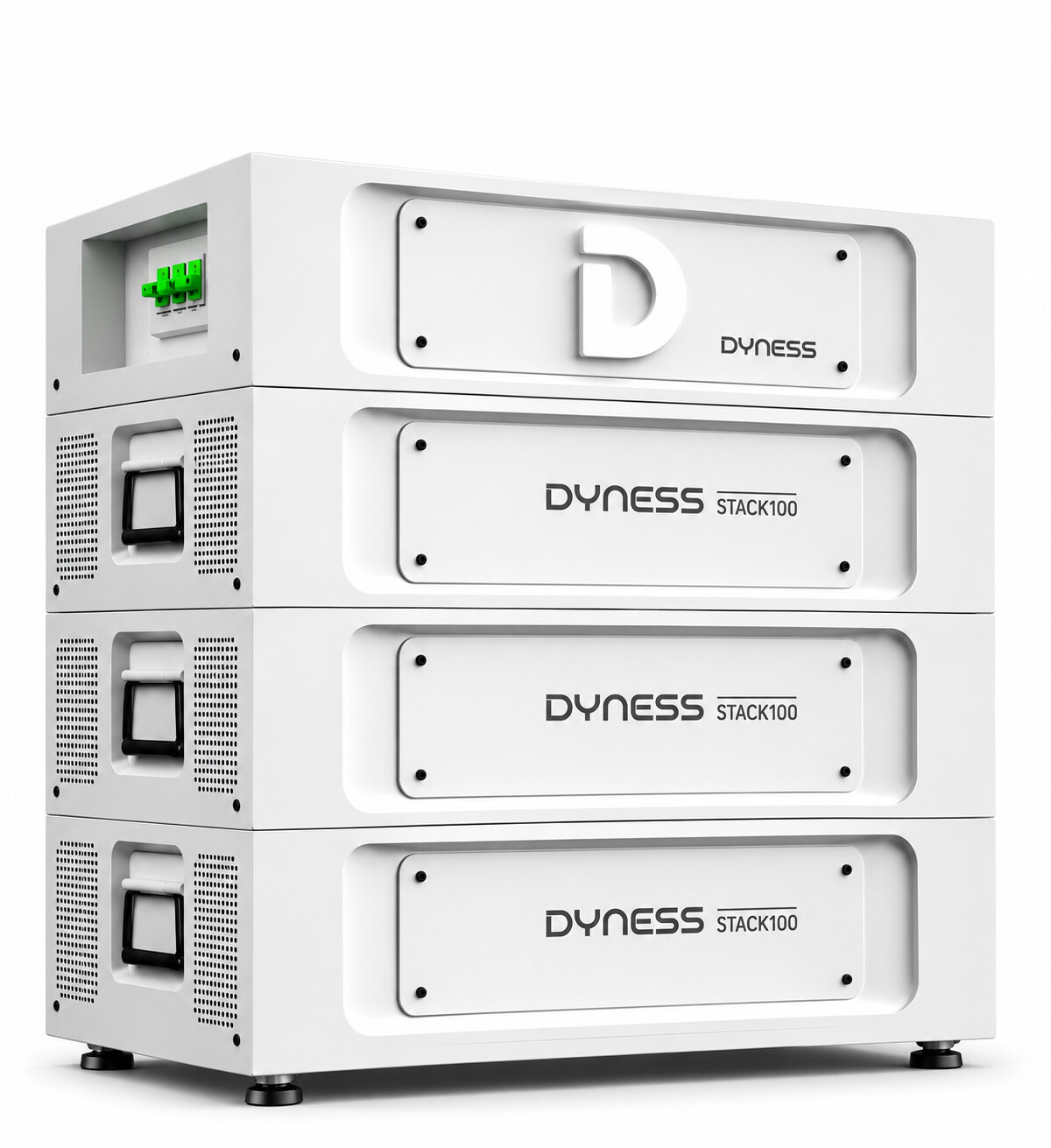



Dyness STACK100 15.36 kWh – Modular High-Voltage Battery Storage for Your PV System
Utilize your self-generated solar power even when the sun isn’t shining: The Dyness STACK100 with 15.36 kWh nominal capacity expands your photovoltaic system with a powerful high-voltage battery storage. The combination of lithium iron phosphate technology, modular stackable design, and intelligent battery management is suitable for private households and commercial businesses that want to utilize their solar power more effectively.
The storage configuration consists of three battery modules, each with 5.12 kWh. With a depth of discharge of 95%, approximately 14.59 kWh of usable battery energy is theoretically available before conversion losses. How much of this can actually be used in daily life depends, among other things, on system settings, temperature, and any established backup power reserve.
Your Advantages at a Glance
- 15.36 kWh nominal capacity: three modules of 5.12 kWh each for storing your solar power.
- LiFePO4 battery technology: designed for durable and regular storage operation.
- Modular design: flexible system planning through stackable battery modules.
- Space-saving installation: compact design for suitable indoor spaces.
- Integrated aerosol extinguishing system: additional component of the safety concept.
- Intelligent battery management: battery monitoring and automatic cell balancing.
- Digital connectivity: communication via CAN and RS485, as well as integrated WLAN with app and OTA function.
Utilize more of your own solar power in everyday life
A photovoltaic system often generates a particularly large amount of energy when the electricity demand in the building is low. The Dyness STACK100 High-Voltage Storage System makes it possible to temporarily store this surplus and use it later. For example, solar power generated during the day can be used in the evening for lighting, household appliances, or other consumers.
This can increase self-consumption and reduce electricity drawn from the public grid. The appropriate storage size depends on the consumption profile, the output of your PV system, and the desired application area. With a nominal capacity of 15.36 kWh, this configuration provides a basis for households with higher energy demands and smaller commercial applications.
LiFePO4 Technology with a Sophisticated Safety Concept
The STACK100 uses lithium iron phosphate cells. This cell technology is established for stationary energy storage and is suitable for recurring charging and discharging cycles. The integrated battery management system monitors important operating parameters and supports coordinated operation of the individual cells.
Protection functions against overcurrent, overvoltage, impermissible temperatures, and deep discharge complement the system. In addition, there is an integrated aerosol extinguishing system and active air cooling. Together, these components form the safety and temperature management of the battery storage system.
Stackable Design for Flexible Storage Planning
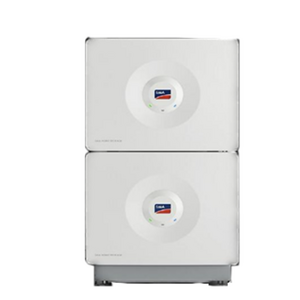
The battery modules are arranged compactly one above the other. This means the storage system requires only a small footprint and can be neatly integrated into suitable technical or utility rooms. The modular concept also facilitates adapting the system size to different energy requirements.
Any subsequent expansion must be planned according to the manufacturer’s current specifications. Key factors include the inverter used, the permissible battery voltage, and the approved number of modules. The version described here includes a battery capacity of 15.36 kWh.
Combining Inverter and Storage System Appropriately
The battery storage system exchanges operating information with a compatible inverter via CAN and RS485. Approval must always be checked for the specific inverter model, firmware version, and selected battery configuration. A brand name alone does not mean that every device of that brand is compatible with the storage system.
Especially with a three-module configuration, attention must be paid to the
required battery voltage range of the inverter.
The nominal voltage is 153.6 V. For
reliable operation, the storage system and inverter must be
technically coordinated.
For self-consumption, load management, and backup power concepts
In addition to PV self-consumption optimization, the STACK100 can be part
of a system for reducing peak loads or for
backup power supply. Which functions are actually available
is determined by the inverter, the energy management, and the
additionally installed components.
A backup power supply is not created by the battery
alone. This requires a suitable inverter and,
if necessary, additional switching and protective devices.
This allows the storage system to be specifically integrated into an
energy concept suitable for the building.
Technical Data
| Manufacturer / Series | Dyness STACK100 |
|---|---|
| Storage type | High-voltage battery storage |
| Battery technology | Lithium iron phosphate (LiFePO4) |
| Nominal capacity | 15.36 kWh |
| Battery modules | 3 × 5.12 kWh |
| Depth of discharge | 95 % |
| Calculated usable battery energy | Approx. 14.59 kWh at 95 % depth of discharge, before conversion losses |
| Nominal voltage | 153.6 V |
| Communication | CAN / RS485 |
| WLAN | Integrated, with app and OTA update function |
| Cooling | Active air cooling |
| Fire protection system | Integrated aerosol extinguishing system |
| Protection rating | IP20 |
| Charging temperature, standard version | 0 °C to +55 °C |
| Discharging temperature | −20 °C to +55 °C |
| Installation type | Stack mounting in a suitable indoor area |
| Dimensions with three modules (W × D × H) | Approx. 590 × 390 × 632 mm according to manufacturer’s dimension formula |









Reviews
There are no reviews yet.