











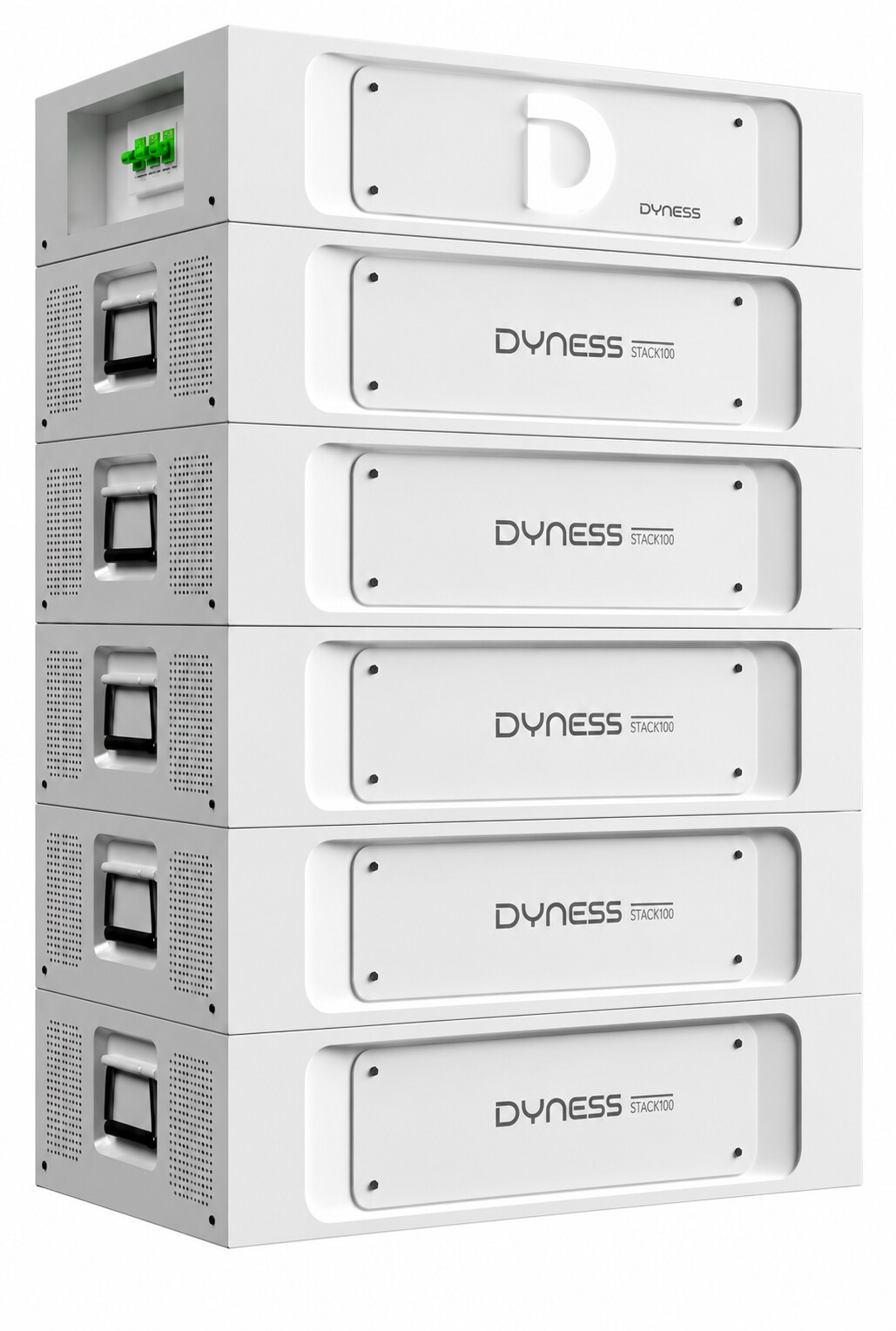



Dyness STACK100 25.60 kWh – High-Voltage Storage for Greater Energy Independence
Use your solar power when you need it:
The Dyness STACK100 25.60 kWh high-voltage battery
stores surplus energy from your photovoltaic system for
later consumption. With five battery modules of 5.12 kWh each,
the system offers generous reserves for demanding private households,
agricultural businesses, and commercial applications.
Whether for heat pumps, household electricity, or commercial consumers:
A suitably dimensioned battery storage system helps to bridge the temporal
gap between solar generation and electricity demand.
The STACK100 combines LiFePO4 cell technology,
intelligent battery monitoring, and a modular stackable design for this purpose.
This allows you to create a flexible foundation for higher
PV self-consumption and less electricity drawn from the grid.
Key advantages at a glance
- 25.60 kWh nominal capacity:
five storage modules, each with 5.12 kWh. - 24.32 kWh theoretically usable battery energy:
at 95% depth of discharge, before conversion and system losses. - Lithium iron phosphate technology:
thermally stable cell chemistry for regular charging and discharging processes. - Modular design:
Expansion options within Dyness system specifications. - Integrated protection concept:
Battery management system and aerosol fire extinguishing system. - Digital connectivity:
CAN/RS485 and integrated WLAN with app and OTA functions. - Compact installation:
Stackable modules with a small footprint.
Utilize more self-generated energy in your own building
A photovoltaic system produces a particularly large amount of electricity when the
sun is high. However, actual consumption is often distributed over
other times of the day. With the
Dyness STACK100 Battery Storage with 25.60 kWh
you can store a portion of the surpluses generated during the day for the
evening, night, or periods of high consumption.
This is particularly interesting for buildings with high electricity demand,
a sufficiently large PV system, and regular solar surplus.
Even with a heat pump or a wallbox in the overall system,
stored solar energy can contribute to self-consumption.
Crucial factors are the available charging energy, the consumption profile,
and the power of the connected inverter.
25.60 kWh capacity with a clear energy balance
The five battery modules combined result in
25.60 kWh nominal capacity. With a planned
discharge depth of 95%, a theoretical
24.32 kWh is available on the battery side.
This allows a significant portion of electricity demand to be shifted to times
without sufficient PV generation.
The energy actually available to your consumers will be lower
due to conversion losses and the system’s own consumption.
Temperature, state of charge, and aging also influence the
result. For appropriate sizing, both
your daily energy demand and the simultaneously required
power should be considered.
LiFePO4 cells and intelligent battery monitoring
The STACK100 uses Lithium Iron Phosphate cells, or LiFePO4
or LFP for short. This technology combines thermal stability with
a high suitability for recurring storage cycles.
The integrated Battery Management System monitors
the cells and supports controlled charging and discharging operations.
Additionally, the system features an
aerosol fire suppression system and active air cooling.
The coordinated components support the protection
of the battery during intended operation. For a reliable
installation, the manufacturer’s installation and connection guidelines
must be followed.
Stackable design with expansion options
Five battery modules arranged one above the other create high
storage capacity on a compact footprint. This facilitates
integration into suitable technical rooms and ensures a
clear system setup.
If your energy demand grows, an expansion within the
STACK100 series can be considered. In this case, the permissible
system configuration, the voltage range of the inverter,
and the manufacturer’s specifications for combining battery modules
must match. Early planning makes it easier to
account for future consumers.
Combinable with compatible high-voltage inverters
The storage system is integrated into a
compatible energy system via CAN and RS485. The nominal voltage of the
five-module configuration is 256 V.
For inverter selection, the approval of the specific
model, including firmware version and number of batteries, is decisive.
Brand compatibility alone is not sufficient.
The integrated WLAN module supports app connectivity and
OTA updates. Backup power, peak load management, or
off-grid operation each require a suitable
overall system. Which functions are usable is determined by
the inverter, control system, and electrical installation.
Technical Data: Dyness STACK100-5S
| Model configuration | Dyness STACK100-5S |
|---|---|
| Battery type | High-voltage battery storage with LiFePO4 cells |
| Nominal capacity | 25.60 kWh |
| Number of battery modules | 5 × 5.12 kWh |
| Depth of discharge | 95% DoD |
| Calculated usable battery energy | 24.32 kWh before system losses |
| Nominal voltage | 256 V |
| Communication | CAN / RS485 |
| WiFi functions | Integrated WiFi module, app connectivity and OTA |
| Battery monitoring | Integrated battery management system |
| Fire protection | Aerosol fire suppression system |
| Cooling | Active air cooling |
| Protection rating | IP20 |
| Charging temperature per manual | 0 °C to +50 °C |
| Discharging temperature per manual | −20 °C to +50 °C |
| Dimensions per manual | 591 × 390 × 901 mm (W × D × H) |
| Weight per battery module | 47 kg |
| Weight of the five battery modules | 235 kg, plus control unit and base |
| Installation | Stack installation in a suitable indoor area |
The specifications for dimensions and temperature ranges refer
to the STACK100-5S configuration in the manufacturer’s manual.
Values may vary depending on the hardware version.
The documentation of the delivered version is authoritative.
Frequently Asked Questions about the Dyness STACK100 25.60 kWh
Who is this storage size suitable for?
For households and businesses with correspondingly high electricity demand
and sufficient PV surpluses. Particularly relevant is the
ratio between solar yield during the day and consumption outside
of sunlit hours. Sizing should be based on the
actual load profile.
Can the storage unit be installed outdoors?
The STACK100 version described here has protection class
IP20 and requires a suitable, dry indoor area.
It is not intended for unprotected outdoor installation.
Will the battery power my house during a power outage?
This is possible with a suitable backup power-capable inverter
and the necessary installation. The battery
alone does not provide a complete backup power supply.
Powerable circuits and available power depend on the
overall system.




Reviews
There are no reviews yet.