









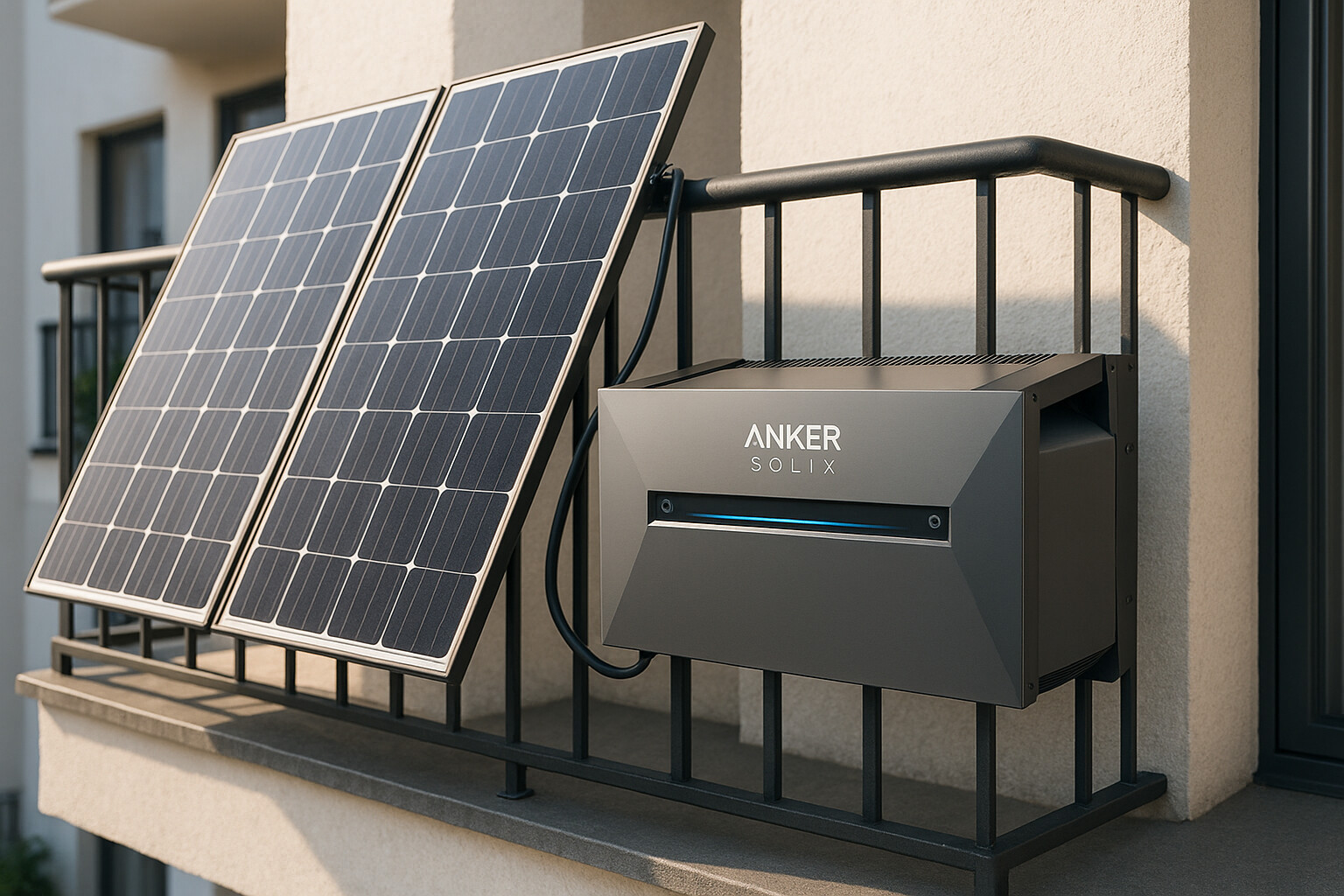
The Anker Solix Solarbank 3 E2700 Pro changes the way balcony power plants can use their self-generated electricity. Balcony power plants have been experiencing a real boom since the legal reform in summer 2024 in Germany and thanks to attractive subsidies and increasing environmental awareness in Austria. However, without intelligent storage, a lot of unused solar power simply dissipates into the grid – this is exactly where Anker’s new flagship comes in.
As the third generation of the popular electricity storage system, the device brings significant improvements. Compared to its predecessor, it offers 68 percent more storage capacity, four separate MPPT trackers for optimal module utilization, and for the first time, the option of grid charging. But do these innovations justify the surcharge?
In this comprehensive Anker Solix Solarbank 3 Pro review, we tested the system in practical use over several weeks. You will learn how the Solarbank performs in everyday life, whether the AI-controlled consumption optimization delivers on its promises, and for which households the investment is truly worthwhile. We also critically examine the price-performance ratio and compare the Solarbank with competing products.
➡ View the Anker Solix Solarbank 3 E2700 Pro in our shop now
What is the Anker Solix Solarbank 3 E2700 Pro? – Basics and Application Area
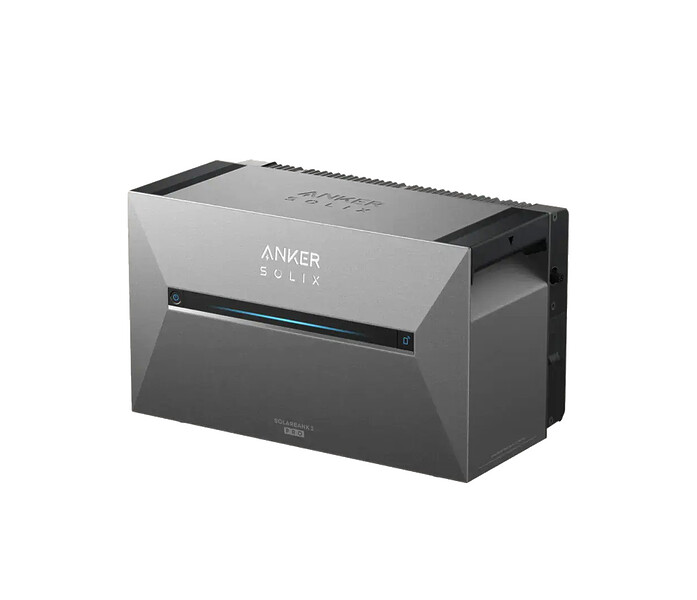
The Anker Solix Solarbank 3 E2700 Pro is an intelligent battery storage system specifically developed for balcony power plants and small photovoltaic systems. The system combines battery, inverter, and intelligent control unit in a weather-resistant aluminum housing. This positions the device at the interface between a classic balcony power plant and a full-fledged mini PV system.
The core task of the Solarbank is to store solar power generated during the day and release it at a later time. This allows you to benefit from your own electricity generation even in the evenings and at night, long after the sun has set. The system operates fully automatically and adjusts power output to your current consumption with pinpoint accuracy.
The most important functions at a glance:
- Intelligent storage of up to 16 kWh (with expansion batteries)
- Automatic consumption adjustment in real-time
- AI-powered optimization for maximum self-consumption
- Bidirectional charging from grid and solar
- Emergency power function in case of power outage
- Expandable from balcony power plant to mini PV system
What makes the system particularly interesting is its flexibility. Starting as a pure balcony power plant with simplified registration, the system can later be easily expanded into a more powerful mini PV system. The target group ranges from tenants with south-facing balconies to homeowners with carports or garage roofs.
Technical Specifications of the Anker Solix Solarbank 3 E2700 Pro at a Glance
| Technical Specification | Anker Solix Solarbank 3 E2700 Pro |
|---|---|
| Model designation | Anker Solix Solarbank 3 E2700 Pro (A17C5) |
| Base unit capacity | 2,688 Wh (2.7 kWh) |
| Max. total capacity | 16,128 Wh (16 kWh) with 5 additional batteries |
| Battery type | Lithium iron phosphate (LiFePO4) |
| Inverter power | 1,200 W (bidirectional) |
| Feed-in power | 600/800/1,200 W (adjustable) |
| Solar inputs | 4 x 900 W (each with MPPT) |
| Max. solar input power | 3,600 W |
| Emergency power output | 1,200 W (1,000 W without additional battery) |
| Dimensions (W×D×H) | 460 × 279 × 254 mm |
| Weight | 29.2 kg |
| Protection class | IP65 (weatherproof) |
| Charge cycles | 6,000 cycles (up to 70% remaining capacity) |
| Warranty | 10 years |
| Service life | approx. 15 years |
Storage Capacity and Expansion Options
The base unit of the Solarbank 3 Pro stores 2,688 watt-hours of electrical energy – a significant leap compared to the 1,600 Wh of its predecessor. This is made possible by a more modern lithium iron phosphate battery with optimized cell density. This LiFePO4 technology is considered particularly durable and safe.
The system becomes truly impressive due to its expandability. You can stack up to five BP2700 additional batteries below the main unit. The expansion options in detail:
- 1 Base Unit: 2.7 kWh capacity
- + 1 BP2700 Battery: 5.4 kWh total capacity
- + 2 BP2700 Batteries: 8.1 kWh total capacity
- + 3 BP2700 Batteries: 10.8 kWh total capacity
- + 4 BP2700 Batteries: 13.4 kWh total capacity
- + 5 BP2700 Batteries: 16.1 kWh total capacity (maximum)
The backward compatibility is also practically implemented. The older BP1600 batteries of the Solarbank 2 Pro can still be used if you already own them. When mixing different battery types, you should simply position the older models at the bottom. The connection between the units is tool-free via a combi plug. The system automatically recognizes all connected batteries and displays their status in the app.
Performance Data and Inverter
The core of the Anker Solix Solarbank 3 E2700 Pro is a bidirectional 1,200-watt inverter. This converts the direct current from your solar modules into grid-compliant 230-volt alternating current. Bidirectional means that the current flow works in both directions – an important innovation compared to its predecessor.
As a registered balcony power plant, the system feeds in a maximum of 800 watts by default, as permitted by German regulations. However, the 1,200 watts of power do not remain unused:
Simultaneous functions possible:
- 800 W feed-in to the household grid
-
- 400 W battery charging
- = 1,200 W total power optimally utilized
This parallel function significantly increases efficiency. On the input side, the Solarbank has four separate connections for solar modules. Each input can handle up to 900 watts peak and has its own MPPT tracker for power optimization. In total, you can connect up to 3,600 watts of module power – however, only 2,000 watts if you want to operate the system as a balcony power plant. For higher outputs, registration as a mini-PV by an electrician is required.
Dimensions and Weight
The Anker Solix Solarbank 3 E2700 Pro measures 460 x 279 x 254 millimeters, maintaining the compact form factor of its predecessor. Thanks to the identical footprint, old and new components can be easily combined. Installation can be done either standing or hanging, depending on the space available on your balcony or terrace.
However, there have been some changes in weight. At a hefty 29.2 kilograms, the main unit weighs significantly more than the previous model. This increase in weight is a direct result of the higher battery capacity. When transporting it to upper floors, you should ideally have two people help or use a hand truck.
The BP2700 expansion batteries have similar dimensions. Fully equipped with five additional batteries, the system stacks up to over one meter in height and weighs more than 170 kilograms in total. This sounds like a lot, but the stable aluminum construction easily withstands this load. The IP65 protection class also guarantees weather resistance – rain and dust cannot harm the electronics.
Anker Solix Solarbank 3 E2700 Pro Price: Costs and Price-Performance Ratio
The Anker Solix Solarbank 3 E2700 Pro price is currently 1,318.80 Euros (27% discount on the RRP of 1,499 Euros). The BP2700 expansion batteries regularly cost 899 Euros, but are often available for less. In our shop, you can purchase the BP2700 expansion battery for 778.80 Euros.
Current price overview in our shop:
- Solarbank 3 E2700 Pro (Base Unit): €1,318.80 instead of €1,499
- BP2700 Expansion Battery: €778.80 instead of €899
- Bundle with 930Wp Solar Modules: €1,799
Complete sets with solar modules often offer the best value for money. Our PV Bundle Full Black with 930 Wp for 1,799 Euros already includes the complete equipment for an immediate start. Some offers even include a free Smart Meter, which normally costs around 100 Euros.
In direct comparison, the Solarbank 3 Pro is priced higher than competitor products such as the Zendure SolarFlow or EcoFlow Stream Ultra. However, you also receive more power and future-proofing. If you calculate the amortization, with an electricity price of 32 cents per kilowatt-hour and favorable conditions, the amortization period is approximately three to five years. With a ten-year warranty and a projected lifespan of 15 years, there is ample time for real savings.
Installation and Commissioning: It’s That Simple
Connecting the Solar Panels
The solar modules are wired using standardized MC4 connectors, which are used with almost all photovoltaic modules. Each module is connected individually to the Solarbank, and you can distribute the modules to the four inputs as desired. For optimal yields, an even distribution is recommended.
Connection Options:
- 4 Modules (Standard): 1 module per input – ideal for balcony power plants up to 2,000 Wp
- 8 Modules (Extended): 2 modules in parallel via Y-cable – only as a registered mini-PV system
If you want to connect more than four modules, you will need Y-cables for parallel connection. You connect two identical modules to form a string, which then goes to one of the four inputs. In this way, theoretically eight modules can be operated. However, please note that this is only permitted with registration as a PV system.
The choice of solar modules is largely up to you. Important electrical characteristics:
- Open-circuit voltage: 16 to 60 volts
- Short-circuit current: maximum 40 amperes
- Module power: ideally 400 to 550 Watt Peak
Modules between 400 and 550 Watt Peak have proven themselves in practice and optimally utilize the input capacity. Various mounting systems are available for installation, from balcony railing clamps to freestanding frames.
Grid connection and legal framework
Connecting to the household grid could hardly be simpler. The Solarbank is connected to any power outlet via a supplied Schuko cable – done. Through this connection, the electricity automatically flows into the household grid, reducing your consumption from the public grid.
As a balcony power plant (simplified registration):
- Maximum 2,000 watts module output
- Maximum 800 watts feed-in power
- Registration only via the market master data register
- No electrician required
- Plug & Play installation possible
As a mini PV system (with an electrician):
- Up to 3,600 watts module output (8 modules)
- Up to 1,200 watts feed-in power
- Registration by a specialist company with the grid operator
- Separate cable to the electricity meter required
As a balcony power plant with a maximum module output of 2,000 watts and an feed-in output of 800 watts, you benefit from the simplified registration rules since the Solarpaket 1. Registration is uncomplicated via the market master data register of the Federal Network Agency. You do not necessarily need an electrician for this variant.
The situation is different if you want to use the full feed-in power of 1,200 watts or operate the system with more than four modules. In this case, a specialist company must register the system as a mini-PV with the grid operator. The installation of a smart meter in the fuse box also requires electrical expertise.
App Setup and WLAN Connection
The initial setup is done via the free Anker app, which is available for iOS and Android. After downloading, you create a user account and scan the QR code on the Solarbank. The device then connects to your home WLAN network. The entire process takes less than five minutes.
A stable WLAN connection at the installation location of the Solarbank is recommended, but not absolutely necessary. Alternatively, control also works via Bluetooth, but only in the immediate vicinity of the device. For remote access and advanced functions such as AI-controlled consumption optimization, however, you need internet.
With an active internet connection, you can monitor and control your system from anywhere in the world. The app displays solar yield, battery level, current feed-in, and consumption data in real time. Subsequent setting changes, such as adjusting the feed-in power or programming schedules, can also be conveniently made via smartphone. The system automatically installs firmware updates via WLAN as soon as new versions are available.
Intelligent Functions and Smart Home Integration
AI-based Consumption Optimization
The Anker Solix Solarbank 3 E2700 Pro uses machine learning to optimize your power usage. After a learning phase of a few days, the system begins to recognize patterns. It analyzes weather forecasts, historical yield data, and your typical consumption profile. From this, the integrated AI calculates predictions for electricity surpluses.
This function is particularly practical on sunny days. Already in the morning, you receive a notification of when surplus solar power is to be expected. This allows you to, for example, specifically plan the washing machine for these time windows. The system continuously learns and adapts its forecasts to changed habits.
The increase in efficiency through this intelligent control is about 15 to 20 percent in practice compared to simple schedules. Households with flexible consumption times particularly benefit significantly. However, the AI function requires a stable internet connection and regular data updates via the cloud. Data protection is uncritical, as only energy data and no personal information are transmitted.
Smart Meter Integration
A real game changer is the integration of a smart meter. This measuring device is installed by an electrician in the fuse box and measures the total electricity consumption of your household in real time. It transmits this data wirelessly via WLAN directly to the Solarbank.
With this information, the system can adjust its operation to the second. For example, if you switch on the kettle, the smart meter immediately registers the increased consumption. The Solarbank then increases its feed-in power by exactly the additional demand within two to three seconds. This minimizes grid consumption to an absolute minimum.
Advantages of Smart Meter Integration:
- Second-accurate adjustment of feed-in power
- Automatic detection of all consumers in the household
- Up to 95% self-consumption rate achievable
- No manual programming required
- Maximum efficiency without smart plugs on every device
Compatible Smart Meters:
- Anker Smart Meter (€99 in our shop) – recommended
- Shelly Pro 3EM
- Installation by electrician: €100-200 labor costs
Those who have the opportunity should definitely make this investment. Consumption optimization with a Smart Meter is significantly more precise than with smart plugs or schedules alone. The Anker Smart Meter is available from us for 99 Euros and is often already included in bundle offers.
Smart Plugs as an Alternative
If a Smart Meter installation is not possible, Anker Smart Plugs offer a practical alternative. These Wi-Fi plugs are inserted between the device and the wall socket and then communicate directly with the Solarbank. Each plug reports the power consumption of the connected device in real time.
The Solarbank can specifically control these devices. For example, if the system detects an expected power surplus in the morning, it automatically switches on the e-bike charger or the filament dryer. After full charge or when solar yield decreases, it switches off automatically. You can also prioritize multiple Smart Plugs to set a sequence.
In addition to automation, the plugs offer additional convenience functions. They act as a timer, display the real-time consumption of individual devices, and can also be switched manually via the app – practical for fairy lights or aquarium pumps, for example. At about 30 Euros per plug, they are significantly cheaper than a Smart Meter, but do not fully replace it, as they can only monitor individual devices.
Dynamic Electricity Tariffs
As the first balcony power plant storage system of its kind, the Anker Solix Solarbank 3 E2700 Pro supports the integration of dynamic electricity tariffs. Specifically, integration with the Nord Pool electricity exchange is currently implemented. There, prices fluctuate hourly depending on supply and demand in the European electricity grid.
The basic idea: On sunny afternoons, when solar power is abundant, exchange prices often drop to a few cents per kilowatt-hour. The Solarbank then charges its battery cheaply from the grid. In the evenings and at night, when electricity becomes more expensive, you release the stored energy. This way, you save money even without your own solar modules and simultaneously relieve the grids.
However, suitable end-customer tariffs in Germany that actually pass on these exchange prices are still missing. Furthermore, the concept would only truly pay off with grid-serving storage tariffs, where grid fees are also variably structured. The Solarbank is already technically prepared for this. As soon as corresponding tariff models become available, you can benefit from them via a software update – a clever investment in the future.
Anker Solix Solarbank 3 Pro Test: Practical Experience in Everyday Use
In the comprehensive Anker Solix Solarbank 3 Pro test, we examined the system over several weeks under real conditions. The results impressively demonstrate how powerful modern balcony power plant storage systems have become. From energy yield in different weather conditions to intelligent consumption control – here you will find all the practical details.
Energy Yield in Various Weather Conditions
In bright sunshine, the Anker Solix Solarbank 3 E2700 Pro demonstrates its full performance. With four 500-watt modules facing south, peak outputs of over 1,800 watts were regularly observed during April days in the test. By early afternoon, the Solarbank and an additional battery had already reached their full capacity of almost 5.4 kilowatt-hours combined.
Test Results under Different Conditions:
| Weather Condition | Module Output | Daily Yield | Self-Consumption |
|---|---|---|---|
| Sunny (April) | 1,600-1,900 W | 10-12 kWh | 95% |
| Partly Cloudy | 800-1,200 W | 6-8 kWh | 92% |
| Heavily Cloudy | 400-600 W | 3-5 kWh | 88% |
| Overcast (Diffuse Light) | 200-400 W | 1-3 kWh | 85% |
It becomes more interesting in changeable weather conditions. Even with a completely overcast sky, the modules still delivered an astonishing 400 to 600 watts. This diffuse light is sufficient to completely cover base loads such as the refrigerator, router, and standby consumers. Modern solar modules do not only work efficiently in bright sunshine.
Over a typical spring day, between 8 and 12 kilowatt-hours of solar power could be harvested – significantly more than the storage capacity. From April to September, such a system easily covers 60 to 80 percent of the electricity needs of an average two-person household.
Storage Efficiency
The storage efficiency of the Anker Solix Solarbank 3 E2700 Pro is approximately 92 percent. This means that out of 100 watt-hours stored, 92 can be retrieved – a very good value for this device class. The losses mainly arise from conversion losses in the inverter and slight self-discharge of the battery.
Efficiency values in detail:
- Storage Efficiency: 92% (Charging + Discharging)
- MPPT Efficiency: 99.5% per tracker
- Response Time with Smart Meter: 2-3 seconds
- Control Accuracy: ±5 watts
- Self-consumption Rate: up to 95% achievable
The control accuracy was particularly impressive in the test. With a connected smart meter, the system adjusts its feed-in to precisely match household consumption within two to three seconds, accurate to within a few watts. If a 2,000-watt kettle is switched on, the Solarbank immediately jumps to its maximum 800 watts of feed-in power. The remaining 1,200 watts then come from the grid – but only those.

Matthias Schiestl and his team are always ready to help you reliably and quickly with any questions and with how you can use the devices reliably and efficiently in your everyday life. » learn more about us
+43 676 88731200 9 AM - 12 PM weekdays info@pv-24.at
Thanks to this precise regulation, accidental feeding into the public grid drops to under five percent of total generation. Without storage, however, 30 to 50 percent of solar power from typical balcony power plants goes unused. The statistics in the app show in black and white how efficiently your system is working.
Practical Application Scenarios
3D printers prove to be ideal consumers for surplus solar power. A typical FDM printer constantly draws 150 to 300 watts for several hours while operating. The Solarbank can completely supply such continuous consumers with self-generated energy during the day. Anyone operating a small print farm can thus fully exploit the potential of a balcony power plant.
Ideal Consumers for Balcony Power Plants:
Continuous Consumers (running constantly):
- Refrigerator & Freezer: 50-150 W
- WLAN Router & Smart Home: 10-30 W
- Surveillance Cameras: 5-15 W per camera
- NAS System: 20-50 W
- Aquarium Technology: 30-100 W
Flexible Consumers (can be switched on when there is a surplus):
- E-bike charging: 200-300 W for 2-3 hours
- Filament dryer: 150-200 W
- Charging battery tools: 50-150 W
- Home cinema system: 100-300 W
- Washing machine: 400-2,000 W (phases)
E-bikes also benefit from the system. An average 500 watt-hour battery is fully charged in two to three hours – perfect for sunny midday hours. With a smart socket and AI control, the bike automatically charges only when there is a surplus of electricity. This way, you make optimal use of practically every ray of sunshine.
Home cinema systems, aquariums, or larger NAS systems are other grateful consumers. Refrigerators and freezers can also be permanently supplied with solar power via the set basic demand. It becomes exciting with smart fan heaters or infrared heaters during the transitional period – on sunny autumn days, surplus solar energy can be directly converted into heat.
Bidirectional charging in test
The ability for bidirectional charging significantly expands the range of applications. In normal operation, the Solarbank charges its battery with solar energy during the day and releases power in the evening. However, the Anker Solix Solarbank 3 E2700 Pro can also draw power from the public grid and temporarily store it in the battery.
This function makes particular sense in winter when solar yields are low. Overnight, the battery charges with inexpensive night-time electricity, which you then consume during the day. Although you pay for this electricity, it is usually at a lower tariff than during peak load times. With a low tariff of about 22 cents at night compared to 35 cents during the day, there is potential for savings.
The concept becomes even more interesting with dynamic electricity tariffs. At 1 p.m., when wind power and photovoltaics produce surpluses across Germany, exchange prices often fall to below 5 cents per kilowatt-hour. The Solarbank then charges cheaply from the grid, while avoiding expensive peak-load electricity in the evening. This way, your balcony power plant storage becomes a grid-serving buffer storage that stabilizes power grids and saves money.
Emergency power function: Autonomy in case of power outage
The integrated emergency power socket offers real security for emergencies. You can operate devices with up to 1,200 watts of power at this special socket on the Solarbank – completely independent of the house grid. Without an additional battery, at least 1,000 watts are available, which is sufficient for most scenarios.
In the event of a power outage, the system does not automatically switch to emergency power operation. You must manually plug consumers into the emergency socket. However, this is a safety measure that prevents electricity from being accidentally fed into the disconnected grid. Once the plug is in, the Solarbank reliably supplies energy from the battery or connected solar modules.
With a full 2.7 kilowatt-hour charge, you can, for example, operate a laptop and router for about 20 hours. A refrigerator runs for about 15 hours, and LED lighting for several days. With five additional batteries and 16 kilowatt-hours of capacity, you achieve true autonomy for several days. For German conditions with rare power outages, this may sound exaggerated, but the function is immensely reassuring – and is perfect for camping trips or garden shed use.
App and user interface: Operation in practical test
The Anker app is clear and intuitive to use. On the start page, you can see the most important key figures at a glance: current solar yield, feed-in power, battery level, and household consumption. An energy flow diagram clearly visualizes where electricity comes from and where it flows. This real-time display certainly has addictive potential.
The menu contains detailed statistics for various periods. Daily, weekly, monthly, and annual views show yield curves, consumption patterns, and feed-in statistics. The comparison displays are particularly helpful, for example, between different modules or months. This allows you to quickly detect if a module is dirty or in the shade.
The control functions range from simple settings like feed-in power to complex schedules and automations. For each function, there are help texts that clearly explain what lies behind the options. The app installs updates automatically, and new features are announced via push notification. With an average of 4.5 stars from over 3,000 reviews in the App Store, the Anker app is significantly above the industry average and makes operation a pleasure.
Anker Solix Solarbank 3 E2700 Pro Experiences: Pros and Cons
After several weeks of intensive use, we have been able to gather extensive Anker Solix Solarbank 3 E2700 Pro experiences. The system has impressed in many areas but also shows some weaknesses. Here you will find an honest and balanced evaluation of all strengths and weaknesses from practical use.
Advantages and Disadvantages in Direct Comparison
| Advantages | Disadvantages |
|---|---|
| 68% more storage than the previous model (2.7 kWh instead of 1.6 kWh) | Higher purchase price (€1,318 instead of ~€700-900 for competitors) |
| 4 separate MPPT trackers for optimal module yield (up to 10-15% more yield) | High weight (29.2 kg main unit, over 170 kg fully expanded) |
| Bidirectional 1,200W inverter (simultaneous charging & feeding in) | Expensive expansion batteries (€779 per BP2700) |
| Expandable up to 16 kWh total capacity | Transport problematic to upper floors without an elevator |
| Emergency power function with 1,200W output | Smart meter costs extra (€99 + electrician €100-200) |
| AI-driven consumption optimization with weather forecast | Electrician required for smart meter installation |
| Smart meter integration for second-accurate regulation | Wi-Fi dependency for full functionality |
| Preparation for dynamic tariffs (Nord Pool) | 800W limit in Germany (1,200W unused without PV registration) |
| Intuitive app with real-time monitoring | Longer amortization period than cheaper systems |
| IP65 protection class (fully weatherproof) | No minimum reserve charge adjustable above 10% |
| 10-year warranty on all components | Home Assistant integration only via third-party plugin |
| 15-year lifespan projected | Space requirement when fully equipped (over 1 meter in height) |
| 6,000 charging cycles with 70% remaining capacity | |
| Compatible with older BP1600 batteries | |
| Automatic firmware updates |
Detailed Evaluation of Benefits
Our Anker Solix Solarbank 3 E2700 Pro experiences consistently show positive aspects. First and foremost is the significantly increased storage capacity of 2,688 watt-hours – 68 percent more than its predecessor with identical dimensions. This capacity is sufficient to supply a two-person household with base load overnight.
The four separate MPPT trackers allow for maximum flexibility in module placement. Each panel is individually optimized, even if modules have different orientations or shading. This individual optimization increases the overall yield by approximately 10 to 15 percent compared to simpler systems.
The Solarbank’s expandability makes it particularly future-proof. Start small with the base unit and expand later as needed – up to 16 kilowatt-hours of storage are possible. The transition from a balcony power plant to a registered mini-PV system with 1,200 watts of feed-in can also be achieved without hardware replacement.
Detailed Evaluation of Disadvantages
Despite many advantages, our Anker Solix Solarbank 3 E2700 Pro experiences also reveal some weaknesses. The significantly higher purchase price compared to simpler systems is particularly noticeable. At over 1,400 Euros for the base unit, it is in the premium segment. Cheaper competitor products sometimes cost only half as much.
The considerably increased weight makes installation difficult. At 29 kilograms for the main unit and similar weights for additional batteries, transport becomes a two-person job. For rented apartments on upper floors without an elevator, this can be a real impediment.
The smart meter installation absolutely requires an electrician and incurs additional costs of 100 to 200 Euros. Without this measuring device, consumption optimization remains significantly less accurate. While smart plugs are an alternative, they do not record total consumption. The WLAN dependency for full functionality could also become problematic in basements or outdoor installations.
Economic Efficiency and Amortization: When Does the Purchase Pay Off?
The economic efficiency calculation for the Anker Solix Solarbank 3 E2700 Pro is complex, as many factors play a role. As a basis, we assume a realistic scenario: Solarbank with an additional battery, four 500-watt modules, and a smart meter for a total of approximately 2,300 Euros. With an electricity price of 32 cents per kilowatt-hour and average site conditions.
Such a system generates approximately 1,600 to 2,000 kilowatt-hours of solar power annually. Without storage, you might use about 40 percent of this directly; with the Solarbank, this value increases to over 90 percent. You therefore consume about 1,500 to 1,800 kilowatt-hours yourself. At 32 cents, this corresponds to an annual saving of 480 to 576 Euros.
This results in a payback period of four to five years. After ten years, still within the warranty period, you will have saved between 2,500 and 3,500 Euros. Over the stated lifespan of 15 years, the savings accumulate to 4,000 to 6,000 Euros. Regionally varying subsidies can significantly improve the calculation. Many municipalities and federal states subsidize balcony power plants with 200 to 500 Euros, which can reduce the payback period to under four years.
Comparison with Competitor Products
In the market for balcony power plant storage, the Anker Solix Solarbank 3 E2700 Pro is positioned in the upper price segment. Various alternatives are available in our range, which may be of interest depending on your requirements. A direct comparison clearly shows the differences.
| Product | Capacity | Inverter | MPPT | Price in our shop | Special feature |
|---|---|---|---|---|---|
| Anker Solix Solarbank 3 E2700 Pro | 2.7 kWh (up to 16 kWh) | 1,200 W bidirectional | 4 × separate | €1,318.80 | AI optimization, smart meter |
| Anker Solix Solarbank 2 E1600 Pro | 1.6 kWh (up to 9.6 kWh) | 800 W | 4 × separate | €849 | Predecessor, cheaper |
| Zendure SolarFlow 800 Pro | 1.92 kWh (expandable) | 800 W | 4 × separate | €777.60 | Compact, good value for money |
| EcoFlow Stream Ultra | variable with AC Pro batteries | up to 2,300 W per battery | 2 × separate | €949 | Decentralized batteries for large consumers |
| Marstek Venus-E 3.0 | 2.56 kWh | 800 W (up to 2,500 W) | AC-coupled | €1,798.80 | Retrofitting existing systems |
Anker Solix Solarbank 2 E1600 Pro (€849): The direct predecessor costs approximately €470 less and still offers solid capacity at 1.6 kWh. A good choice for pure balcony power plant users without expansion plans. However, it lacks bidirectional charging and preparation for dynamic tariffs. Available in our shop as a bundle with 2x 445Wp modules for €1,499.
Zendure SolarFlow 800 Pro (€777.60): With 1,920 Wh capacity and four MPPT trackers, the Zendure offers a more affordable alternative. The price is approximately €540 less than the Anker Solarbank 3 Pro. However, its expandability is more limited, and it lacks AI optimization. The bundle with 2x 465W modules costs €999 in our shop.
EcoFlow Stream Ultra (€949): EcoFlow pursues a different concept with decentralized AC Pro batteries, which are placed directly at large consumers. Ideal for households with multiple high-power devices. However, it is more complex to install and lacks central control like Anker.
Marstek Venus-E 3.0 (€1,798.80): The AC-coupled system from Marstek is particularly suitable for retrofitting existing PV systems. With 2.56 kWh and up to 2,500W emergency power, it offers similar capacity but costs approximately 480 Euros more than the Anker Solarbank 3 Pro.
Unique Selling Points of the Anker Solix Solarbank 3 E2700 Pro:
- Highest expandability up to 16 kWh (no competitor offers more)
- Four separate MPPT trackers with 900W input power each
- Bidirectional charging prepared for dynamic tariffs
- AI-controlled optimization with weather forecast
- 1,200W inverter (parallel function even with 800W operation)
Purchase recommendation by intended use:
- Maximum future-proofing: Anker Solix Solarbank 3 E2700 Pro
- Best value for money: Zendure SolarFlow 800 Pro
- Discontinued model at a good price: Anker Solix Solarbank 2 E1600 Pro
- Large consumer control: EcoFlow Stream Ultra
- Retrofitting a PV system: Marstek Venus-E 3.0
For pure balcony power plant users without expansion plans, the more affordable Zendure may suffice. Those planning long-term, valuing future-proofing, or wishing to upgrade to mini-PV later will find the Anker SOLIX Solarbank 3 Pro to be the most flexible solution. The higher initial investment pays off through longer usability and more expansion options.
Who benefits from the Anker Solix Solarbank 3 E2700 Pro?
The Anker Solix Solarbank 3 E2700 Pro is primarily aimed at tech-savvy homeowners and tenants with long-term residency. Those willing to invest in a high-quality solution and use it for many years will make the right choice here. The system is particularly worthwhile for households with a higher base consumption of over 2,500 kilowatt-hours annually.
Ideal candidates have a south-facing balcony, terrace, or garage roof with at least four square meters of free space. A stable Wi-Fi signal at the installation location significantly improves usability. The possibility of smart meter installation should also be given, although the system also works without it.
Tenants benefit from the mounting systems that can be installed without leaving residues, but should realistically assess their tenancy. If a move is planned within three years, the investment will hardly pay off. Homeowners, on the other hand, can consider the system a permanent fixture and even expand it into a full-fledged PV system later. Those who already operate a balcony power plant and are dissatisfied with its self-consumption will find the Solarbank to be the ideal addition for significantly better autonomy.
Warranty, Support, and Manufacturer Service
Anker grants a generous ten-year warranty on the Solix Solarbank 3 E2700 Pro. This covers material defects and malfunctions, but not damage due to improper use or force majeure. After 6,000 charging cycles, the manufacturer guarantees at least 70 percent remaining capacity – a value you will realistically only reach after ten to twelve years.
Anker estimates the lifespan to be 15 years, with continued use at reduced capacity still possible thereafter. For context: with daily full charging, 6,000 cycles correspond to approximately 16.5 years. In practice, the battery is not fully charged and discharged daily, so the actual lifespan is likely to be significantly higher.
Customer service is available via email, phone, and live chat. Response times in the test were under 24 hours, usually even faster. An extensive knowledge base is also available for technical questions. Software updates are carried out automatically via Wi-Fi and regularly bring new functions. The active community in forums and social media also helps with practical questions.
Conclusion: Anker Solix Solarbank 3 Pro Review
The Anker Solix Solarbank 3 E2700 Pro leaves a consistently positive impression in the detailed Anker Solix Solarbank 3 Pro Review. The system combines high storage capacity, sophisticated technology, and excellent expandability in a weatherproof package. Compared to its predecessor, it offers noticeable improvements that justify the extra cost.
Our overall rating: 9.2/10 points
| Evaluation Criterion | Points | Comment |
|---|---|---|
| Storage Capacity | 10/10 | 2.7 kWh base, expandable up to 16 kWh |
| Technical Equipment | 9.5/10 | 4 MPPT, 1,200W inverter, bidirectional |
| Intelligent Functions | 9/10 | AI optimization, smart meter, dynamic tariffs |
| Installation & Operation | 8.5/10 | Simple, but high weight |
| Apps & Software | 9.5/10 | Intuitive, extensive statistics |
| Value for Money | 8.5/10 | Premium price, but worthwhile in the long term |
| Expandability | 10/10 | Best expansion options on the market |
| Warranty & Support | 9.5/10 | 10-year warranty, good service |
The future-proofing particularly impressed us in our test. What starts as a simple balcony power plant can later be expanded into a powerful mini-PV system with up to 16 kilowatt-hours of storage. The four MPPT trackers, bidirectional charging function, and preparation for dynamic tariffs make the device ready for future developments in the electricity market. Those who invest today will benefit for many years.
Installation is remarkably straightforward; only the smart meter integration requires an electrician. The app impresses with its clarity and extensive statistics. In daily operation, the system works reliably and efficiently, and the AI control noticeably optimizes self-consumption.
Who benefits from this purchase?
Our purchase recommendation for:
- Homeowners with long-term planning
- Tech enthusiasts with high self-consumption
- Users who want to upgrade to mini-PV later
- Households with flexible consumption times
- Those interested in dynamic electricity tariffs
Consider alternatives for:
- Budget-conscious beginners (see Zendure SolarFlow 800 Pro)
- Tenants planning to move within 3 years
- Users without Wi-Fi at the installation site
- Simple balcony power plants without expansion plans (see Anker Solarbank 2 Pro)
Criticisms remain the heavy weight and the ambitious price. However, those who plan long-term, appreciate technical innovations, and value quality will find the Anker Solix Solarbank 3 E2700 Pro to be one of the best balcony power plant storage systems on the market. For future-oriented users and tech enthusiasts, we issue a clear purchase recommendation.
➡ Order the Anker Solix Solarbank 3 E2700 Pro now in our shop
Current: 27% discount on RRP – Bundle offers with solar panels available
Frequently Asked Questions (FAQ)
How long does the installation take?
The pure hardware installation takes about two to three hours for technically skilled individuals. Setting up the Solarbank, mounting the modules, and wiring can be done without special tools. The app setup requires another 10 to 15 minutes. If you want to have a smart meter installed, you should plan an additional 30 to 60 minutes of electrician time.
Can I use the Solarbank 3 Pro without a smart meter?
Yes, the system works completely even without a smart meter. However, you will then have to control the feed-in power manually via schedules or use smart plugs. The efficiency will be significantly lower than what is possible with a smart meter. For optimal self-consumption rates, the measuring device is therefore highly recommended, but not absolutely necessary.
How much electricity can I store daily?
The base unit stores 2,688 watt-hours, which corresponds to the daily consumption of a frugal one-person household. With an additional battery, the capacity doubles to 5.4 kilowatt-hours – sufficient for two to three people. However, the amount of storage depends heavily on the solar yield. On sunny summer days, you can easily fully charge the storage, while in winter, it often only suffices for partial charges.
Is the Solarbank suitable for rented apartments?
Basically yes, because since Solar Package 1, balcony power plants may also be installed by tenants without the landlord’s consent. Anker’s mounting systems allow for residue-free installation without drilling. However, pay attention to the statics of your balcony, as the fully expanded system can weigh over 100 kilograms. If you plan to move, you should realistically estimate the amortization period.
Which solar panels are compatible?
Almost all commercially available solar modules with MC4 connectors work. The electrical specifications only need to be in the voltage range of 16 to 60 volts open-circuit voltage. The short-circuit current should not exceed 40 amperes. Modules between 400 and 550 watts peak have proven to be optimal. Pay attention to good quality and certifications for durability.
Can I use existing batteries from previous models?
Yes, the older BP1600 batteries from the Solarbank 2 Pro are compatible with the Solarbank 3 Pro. You can even mix old and new batteries. In this case, you should position the BP1600 at the bottom and stack newer BP2700s on top. The Solarbank automatically recognizes all batteries and manages them intelligently. Software updates ensure long-term compatibility.
How does the emergency power function work?
In the event of a power outage, the Solarbank automatically disconnects from the house grid. You can then operate devices up to 1,200 watts at the special emergency power socket. Power is supplied from the battery or directly from the solar modules, if they receive light. For safety reasons, there is no automatic switchover – you must manually connect consumers to the emergency socket.
Is a dynamic electricity tariff worthwhile with the Solarbank?
In the long term, yes, but currently still limited. The Solarbank is technically prepared for dynamic tariffs and can utilize favorable exchange prices. However, suitable end-customer tariffs are still missing in Germany that actually pass on these prices. As soon as such tariffs become available, the function can be activated via an update. Those who invest now are already prepared for this future.
How long does the battery last?
Anker guarantees 70 percent remaining capacity after 6,000 charging cycles. With daily full charging, this corresponds to approximately 16.5 years. In practice, however, full cycles do not occur daily, so the realistic lifespan should be 15 to 20 years. The ten-year warranty period underlines the quality. After their lifespan, batteries can be professionally recycled.