









Decentralized power generation through photovoltaics is becoming increasingly important for tenants and owners. The question of whether a balcony power plant can be operated as an off-grid system is particularly interesting. While conventional mini solar systems feed their generated electricity directly into the house grid, an off-grid system functions completely autonomously without a grid connection. This distinction is crucial for planning your solar power supply.
The term “balcony power plant as an off-grid system” describes a compact photovoltaic system that operates independently of the public power grid and stores its energy in batteries for later consumption. Unlike grid-connected operation, there is no feeding of surplus energy. This article clarifies the technical differences, highlights the advantages and disadvantages of both systems, and helps you decide which solution best suits your requirements. You will also learn under what conditions a balcony power plant with storage can be meaningfully operated as an off-grid system.
Fundamentals: What is a Balcony Power Plant?
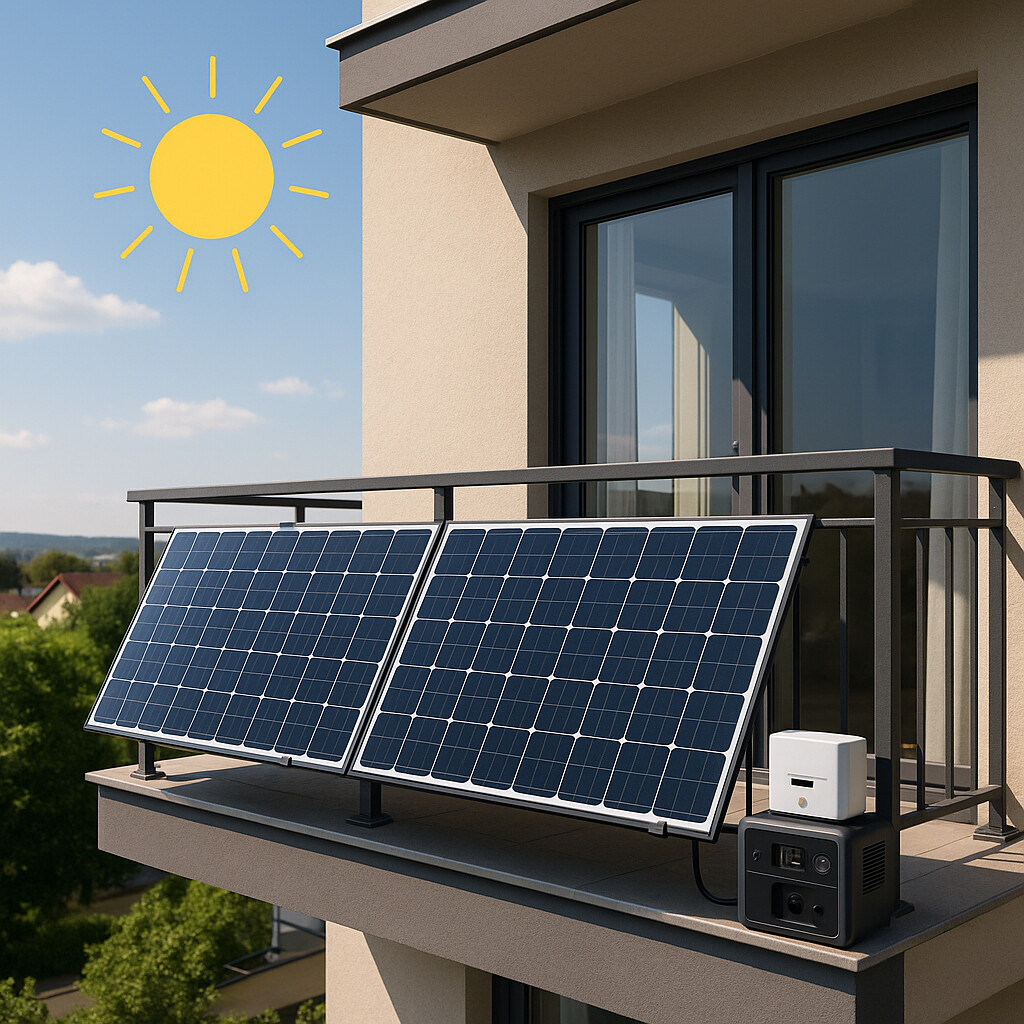
A balcony power plant refers to a compact photovoltaic system with one or more solar modules that can be easily mounted on a balcony railing, facade, or flat roof. The typical output is 600 watts, with systems up to 800 watts also being permitted since 2024. These mini solar systems consist of solar modules, an inverter for converting direct current into alternating current, and a connection cable for the socket.
The functionality is remarkably simple: as soon as sunlight hits the modules, they generate direct current. The integrated inverter converts this into grid-compliant alternating current, which then flows directly into the household circuit via a socket. Electrical devices such as refrigerators, routers, or standby consumers prioritize this solar power. This reduces the electricity drawn from the public grid, which directly impacts the electricity bill.
Installation is tool-free and does not require a specialist company. After mounting at the chosen location, you connect the balcony power plant to a standard household Schuko socket. Registration with the grid operator and in the market master data register is required but is straightforward. This form of power generation is therefore particularly suitable for tenants who cannot or do not want to make extensive structural changes.
What is an Off-Grid System?
A photovoltaic off-grid system operates completely independently of the public power grid and exclusively supplies the connected consumers with self-generated solar power. The term “off-grid operation” describes this autonomous mode of operation without any grid connection. Such systems are typically used in garden sheds, holiday cabins, motorhomes, or at remote locations without a grid connection.
The heart of every off-grid system is a battery storage unit that temporarily stores the solar energy gained during the day. This storage allows electricity to be used at night or on cloudy days. In addition, a balcony solar system in off-grid operation requires a special charge controller that protects the battery from overcharging and deep discharge. Unlike a grid-connected balcony power plant, no surplus energy is fed into the public grid.
The dimensioning of an off-grid system depends on the daily electricity consumption and the devices to be supplied. Module output, storage capacity, and inverter output must be coordinated. Precise planning is crucial, as supply gaps can occur if the system is insufficiently designed. Especially in the winter months with low solar radiation, it becomes apparent whether the system has been adequately dimensioned. Applications can be found wherever no grid supply is available or where autonomy is deliberately sought.
Balcony Power Plant or Off-Grid System – The Difference
Grid-Connected Balcony Power Plant
The conventional balcony power plant feeds its generated electricity directly into the house grid via the socket. As soon as the solar modules produce energy, it is immediately available for all connected household appliances. If you are currently consuming less electricity than the balcony power plant generates, the surplus energy automatically flows into the public grid. This concept does not involve intermediate storage.
The biggest advantage lies in the permanent grid connection: if solar production is insufficient, your household automatically draws electricity from the public grid. This supply security makes additional battery storage unnecessary, which significantly reduces acquisition costs. A balcony power plant 600W off-grid system, on the other hand, would only function without storage if the sun is shining and consumers are connected at the same time.
Installation is uncomplicated: attach modules to the balcony, connect the inverter, plug the connector into the socket – done. Registration with the grid operator has been significantly simplified since the latest legislative changes. Many users appreciate this pragmatic solution, which contributes to their own electricity supply without complex technology. Although surplus feed-in is often free of charge, it nevertheless significantly reduces overall electricity costs through the self-consumption share.
Pure Off-Grid System
A pure off-grid system deliberately foregoes any connection to the public power grid. All generated energy is stored in batteries and used exclusively for self-consumption. This complete autonomy also means that if the batteries are depleted and there is no sunlight, no power supply can be guaranteed. Therefore, off-grid operation requires precise planning and often oversized storage capacities.
The difference between an off-grid system and a balcony power plant is particularly evident in system complexity: while a grid-connected system requires few components, an off-grid system additionally needs charge controllers, battery storage, and often a special off-grid inverter. These components must be perfectly coordinated to ensure a stable power supply. Technical defects can quickly lead to a complete supply interruption without a grid connection.
Despite these challenges, off-grid operation offers maximum independence from energy suppliers and grid fees. For locations without a grid connection, this solution often represents the only practical option. Even with deliberately sought energy autonomy, complete self-sufficiency justifies the higher technical and financial effort. In the long term, this independence enables planning security, as external electricity price fluctuations no longer play a role.
Balcony Power Plant vs. Off-Grid System: Advantages and Disadvantages Compared
| Criterion | Grid-connected plug-in solar system | Off-grid system |
|---|---|---|
| Acquisition costs | €500–1,200 | €2,000–5,000 |
| Installation | Very easy, without a specialist | Complex, specialist knowledge recommended |
| Supply reliability | 100% through grid connection | Depends on storage and weather |
| Degree of self-sufficiency | 10–30% | Up to 100% possible |
| Grid independence | No | Complete |
| Maintenance effort | Minimal | Medium (battery maintenance) |
Advantages of Balcony Power Plants
Grid-connected balcony power plants impress with their uncomplicated installation and low acquisition costs. Without expensive battery storage, the investment is significantly lower than that of a comparable off-grid system. Installation requires no specialized knowledge and can be completed within a few hours. Especially for beginners in solar energy, this system offers low-threshold access to their own electricity generation.
The permanent grid connection guarantees continuous power supply, even when the solar modules are not producing energy. At night, on cloudy days, or in winter, grid power is always available. This supply security eliminates the risk of power outages due to depleted batteries. At the same time, you use the self-generated solar power during the day, thereby noticeably reducing your electricity costs.
Legally, operators benefit from simplified registration processes and low bureaucratic hurdles. Registration in the market master data register is done online within a few minutes. A balcony power plant is also an attractive option for tenants, as it can be easily dismantled and taken with them when moving out. Maintenance is limited to occasional cleaning of the modules – further care is hardly necessary.
Advantages of Off-Grid Systems
Complete independence from the public power grid makes off-grid systems particularly attractive for those striving for self-sufficiency. Electricity price fluctuations, grid fees, and basic charges no longer play a role. With a balcony power plant off-grid system with sufficiently dimensioned storage, you can supply yourself completely with energy. This independence creates long-term planning security and protects against rising energy costs.
Technically, off-grid operation allows for flexible site selection without dependence on an existing grid connection. Garden sheds, weekend cabins, or workshops can be easily supplied with electricity, even if there is no grid connection. The stored energy is available around the clock, allowing you to use electrical devices regardless of the time of day or weather conditions.
Matthias Schiestl and his team are always ready to help you reliably and quickly with any questions and with how you can use the devices reliably and efficiently in your everyday life. » learn more about us
+43 676 88731200 9 AM - 12 PM weekdays info@pv-24.at
Environmentally, off-grid systems offer maximum sustainability, as only renewable energy is used. No externally generated electricity from fossil or nuclear sources flows into your consumption. For environmentally conscious users, this represents significant added value. Furthermore, all grid fees and electricity taxes are eliminated, which reduces long-term operating costs to a minimum. With appropriate dimensioning, the higher initial investment pays for itself over the years.
Disadvantages of Both Systems
With grid-connected balcony power plants, surplus electricity is often fed into the grid without financial compensation. If you generate more electricity at midday than you consume, you are essentially giving this energy away to the grid. While self-consumption reduces the electricity bill, the full savings potential is not exploited without storage. Furthermore, you remain dependent on the public grid and do not benefit from complete energy autonomy.
When considering the off-grid system or balcony power plant question, higher acquisition costs speak against off-grid operation. Battery storage, charge controllers, and special inverters significantly drive up the investment sum. Maintenance and eventual battery replacement after a few years incur additional costs. Technical defects can lead to a complete interruption of supply, as no grid connection exists as a backup.
Both systems suffer from seasonal fluctuations in solar yields. In winter, electricity production decreases significantly, meaning that more grid electricity must be drawn for balcony power plants, and supply bottlenecks threaten off-grid systems. Precise demand planning is essential to avoid over- or under-dimensioning. Site factors such as shading or unfavorable orientation affect both systems equally. Ultimately, the optimal choice depends heavily on individual requirements, budget, and site conditions.
Balcony Power Plant with Storage as an Off-Grid System – Is That Possible?
Technically, a balcony power plant with storage as an off-grid system can certainly be realized, but it requires special components and an adapted system configuration. Standard balcony power plants are designed for grid-connected operation and cannot simply be converted into an off-grid system by adding a battery. The crucial difference lies in the inverter: grid inverters require the grid voltage as a reference and do not function without it. For off-grid operation, you need a special off-grid inverter or hybrid inverter.
Necessary Components for Off-Grid Operation:
- Solar modules (e.g., 2 × 400 watts for a 600W off-grid balcony power plant)
- Off-grid or hybrid inverter with battery connection
- Charge controller (often integrated into the inverter)
- Battery storage (lithium-ion recommended, at least 1-2 kWh)
- Connection cables and fuses
The storage capacity must match your daily electricity demand, with experience suggesting that doubling the calculated capacity is advisable. This provides reserves for days with little sun. Practical implementation is more challenging than with simple plug-in solar: wiring between modules, charge controller, battery, and inverter must be done professionally. Safety aspects such as overvoltage protection and correct dimensioning of cable cross-sections are critical. Limitations arise from the limited module area on the balcony: 600 watts of power are rarely sufficient for complete household supply. Realistically, it can power lighting, a refrigerator, and smaller appliances.
Hybrid Solutions: The Best of Both Worlds
Hybrid systems intelligently combine the advantages of grid-connected operation and battery storage. During the day, solar power primarily flows into direct consumption, with excess energy charging the battery. Only when the battery is fully charged is power fed into the grid. In the evenings and at night, the storage covers electricity demand before grid power is drawn. This prioritization maximizes self-consumption while minimizing grid draw and excess feed-in.
Investment costs lie between a pure balcony power plant and the full cost of an off-grid system. Modern storage systems can often be retrofitted, allowing you to start with a simple balcony power plant and add storage later. This flexibility enables staggered investments according to budget and experience. At the same time, grid connection remains as a safety net, ensuring no supply bottlenecks.
Hybrid solutions are particularly attractive for households with high evening and night consumption. Without storage, solar power generated during the day often goes unused, while expensive grid power is drawn in the evening. Battery storage shifts usage over time and significantly increases the degree of self-sufficiency. In the long term, with rising electricity prices or changes in living circumstances, you can flexibly choose between more self-consumption or increased feed-in. This adaptability makes hybrid systems a future-proof solution for many applications.
Which System is Right for Whom?
The decision between an off-grid system or a balcony power plant primarily depends on your supply goals and spatial conditions. A grid-connected balcony power plant is ideal for tenants and owners who want to reduce their electricity costs in an uncomplicated way. If you are at home during the day and operate base load consumers such as a refrigerator or router, you will benefit optimally from direct consumption. The low investment usually pays for itself within 6-10 years.
A grid-connected balcony power plant suits you if:
- You rent your home and want to remain flexible
- Low acquisition costs are a priority
- Continuous power supply is important
- You want to gain initial experience with solar energy
An off-grid system is the right choice for:
- Locations without a grid connection (garden shed, motorhome)
- Desired complete energy autonomy
- Willingness to make a higher investment
- Technical interest and willingness to plan
Hybrid solutions are recommended for owners with a long-term planning horizon who wish to gradually increase their degree of self-sufficiency. Families with high evening consumption particularly benefit from intermediate storage. Additionally, check legal frameworks: tenants require landlord permission, owners in multi-party buildings must involve the owners’ association. Technical requirements such as suitable orientation and lack of shading apply equally to all systems.
Legal and Technical Frameworks
Since January 2024, simplified regulations apply to balcony power plants: registration with the grid operator is no longer required; only registration in the market master data register remains mandatory. This is done online and free of charge within a few minutes. For grid-connected systems up to 800 watts, the existing electricity meter is usually sufficient, and a backstop is no longer strictly necessary. However, older Ferraris meters should be replaced with a bidirectional meter.
Technically, balcony power plants must comply with the DIN VDE 0100-551-1 standard and have protective devices such as NA protection. The inverter must automatically shut down in the event of a power outage to prevent backfeeding. These safety requirements are standard for certified devices. Different regulations apply to off-grid systems, as there is no grid feed-in. Nevertheless, you should have electrical installations carried out professionally or ensure they are done professionally.
In terms of building regulations, balcony power plants usually do not require a permit as long as they are permanently mounted on the building and meet static requirements. Tenants must obtain the landlord’s consent, whereby the landlord may not refuse the installation without good reason. Additional conditions may apply to listed buildings or in special residential areas. For insurance purposes, you should inform your liability insurer; however, private solar systems are usually co-insured. Before installation, check local specifics and seek expert advice if in doubt.
Conclusion
The question “balcony power plant or off-grid system” cannot be answered universally but depends on individual requirements. Grid-connected balcony power plants offer the easiest entry into solar energy with low costs and uncomplicated installation. They are ideal for reducing electricity bills while ensuring supply security through the grid. For maximum self-sufficiency and locations without a grid connection, the off-grid system remains the only alternative, but it requires significantly higher investments and careful planning.
The difference between an off-grid system and a balcony power plant is particularly evident in system complexity and operation: while the grid-connected system is immediately ready for use, off-grid operation requires batteries, charge controllers, and specialized components. Hybrid solutions combine the advantages of both concepts and offer maximum flexibility. They enable a gradual increase in the degree of self-sufficiency while maintaining supply security. For future-oriented users, they often represent the best balance between investment and benefit.
Before making a decision, realistically analyze your electricity needs, available space, and budget. Consider long-term developments such as potential electricity price increases or changes in living situations. Legal frameworks have evolved in favor of balcony power plants, significantly facilitating entry. Regardless of your choice, you make a valuable contribution to the energy transition and benefit from self-generated, environmentally friendly electricity.