









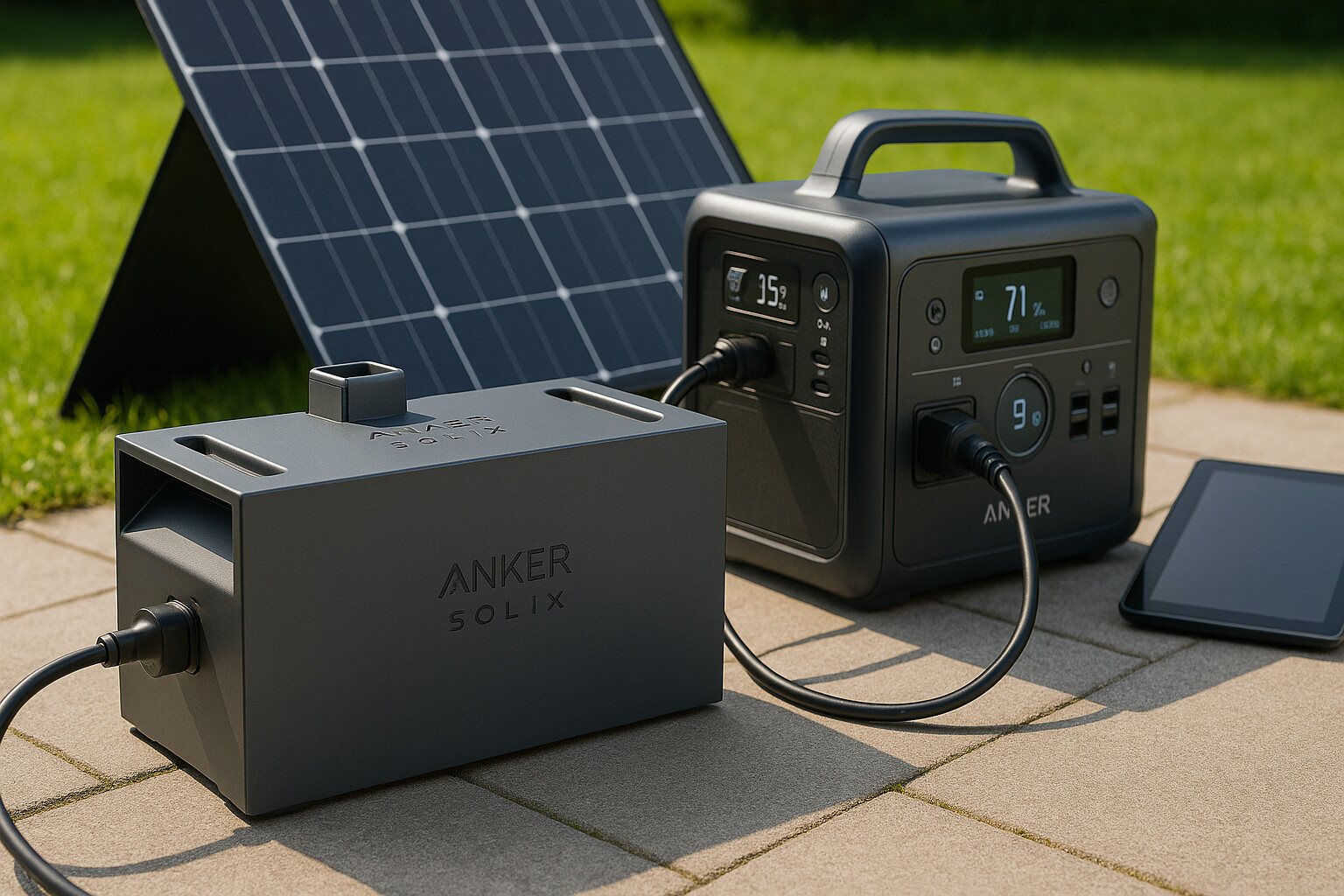
Home storage systems are becoming increasingly important for anyone who wants to reduce their energy costs and become more independent from the power grid. The BP2700 expansion battery is available as an upgrade for existing Solarbank systems. This Anker SOLIX BP2700 Expansion Battery review examines whether the investment in the additional storage is actually worthwhile and what advantages it offers in everyday use.
Many users face the question of whether a capacity expansion is necessary or if the basic system is sufficient. The BP2700 promises not only more storage volume but also higher charging power. Whether these technical features justify the price difference depends heavily on individual electricity consumption and personal goals. This review highlights all relevant aspects – from installation to performance data and everyday usability.
What is the Anker SOLIX BP2700 Expansion Battery?
The BP2700 belongs to the product family of modular energy storage systems and expands existing Solarbank systems with additional capacity. With 2.7 kilowatt-hours, it offers significantly more storage volume than smaller models. The system was specially developed for combination with the Solarbank 3 Pro and can be seamlessly integrated into existing installations.
The device functions as an expansion module and not only increases the available energy amount but also the maximum charging power of the overall system. Unlike pure capacity expansions, the BP2700 thus also influences the speed at which solar power can be stored. This feature makes it particularly interesting for households with high self-consumption.
Technically, the BP2700 is based on proven lithium-ion technology with long-lasting cells. The aluminum construction ensures robustness and efficient heat dissipation. All components are designed for a lifespan of several thousand charging cycles. The modular concept allows for flexible adaptation to changing energy needs over the years.
Technical Specifications in Detail
| Specification | Value |
|---|---|
| Storage capacity | 2.7 kWh |
| Maximum charging power | 2,400 W |
| Charge cycles | approx. 6,000 |
| Weight | approx. 24 kg |
| Housing material | Aluminum |
| Protection class | Weatherproof (outdoor use) |
➡ Anker SOLIX BP2700 Expansion Battery in the PV-24 Shop
The storage capacity of 2.7 kWh makes it possible to cover the electricity needs of an average household for several hours. With a typical daily consumption of 10 to 15 kWh, a significant portion of the evening and night hours can be bridged. The usable capacity is slightly below the nominal value due to battery management.
The weight of approximately 24 kilograms requires stable wall mounting but is still manageable for one person. The dimensions correspond to those of the base unit, resulting in a stackable construction. All connections are weatherproof and suitable for outdoor use. The protection class ensures safe operation even in changing weather conditions.
Particularly relevant is the maximum charging power of 2,400 watts that the overall system can achieve. Without an expansion battery, this value is only 1,200 watts. This doubling means that significantly more energy can be stored on sunny days. The discharge power is based on the needs of the connected consumers and can be precisely controlled via the app.
Scope of Delivery and Packaging
Shipping is carried out in sturdy outer packaging, which offers additional protection during transport. Inside is the actual product packaging with detailed installation instructions in several languages. The multi-layer packaging reliably prevents transport damage and meets the usual standards for electronic products in this price range.
Included in delivery:
- BP2700 Expansion Battery
- 2 metal mounting brackets
- Wall mounting kit with screws and anchors
- Quick start guide (multilingual)
- QR code for digital user manual
- Rubber seals and protective covers
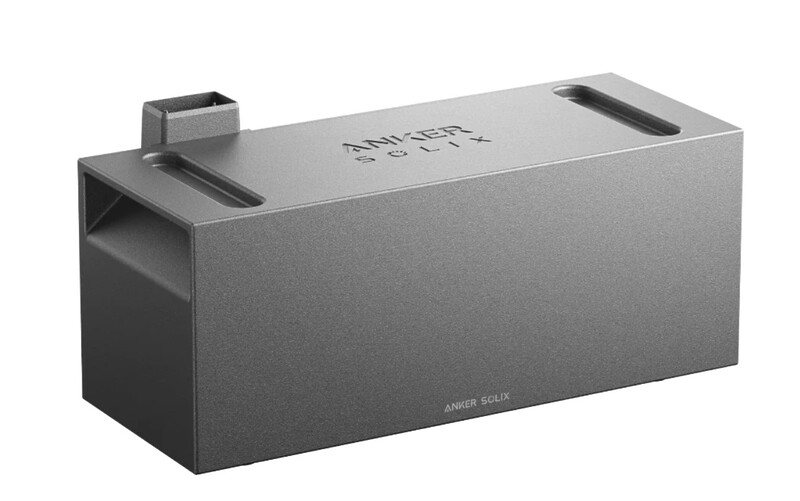
The aluminum surface finish appears high-quality and scratch-resistant. All edges are cleanly processed, and the gaps between the housing parts are uniform. The gray metallic paint visually integrates well into modern home installations. Rubber seals on the connections protect against moisture and dust.
Installation and Commissioning
Step-by-step assembly
Installation begins with preparing the existing system. First, the solar bank must be disconnected from the power grid and all connections released. If solar modules are connected, these should also be disconnected. The five-meter power cable can be easily removed and reconnected later.
On the top of the base unit, there is a screwed-on rubber cover that protects the connection for expansion modules. After loosening two Phillips screws, this cover can be removed. Beneath it, another seal becomes visible, which also needs to be removed. These seals should be stored safely in case the system needs to be returned to its original state later.
The expansion battery is carefully placed on the base unit. Care must be taken to ensure that the contacts meet precisely. The supplied mounting brackets are slid in from the side and secured with the enclosed screws. When lifting the combined system, always use the handles of the lower unit, as the construction may otherwise become unstable.
Electrical Connection and App Setup
After the mechanical connection, the power cable is reconnected, and the system is switched on. The expansion battery activates automatically and begins a self-diagnosis. A light strip on the front indicates the operating status through various color patterns. The entire power-on process takes only a few seconds.
The associated smartphone app automatically recognizes the new configuration on the next start. However, the system first requests a firmware update, which is downloaded via the Wi-Fi connection. This process takes approximately three to five minutes and should not be interrupted. After a successful update, the system restarts, and the expansion battery appears in the device overview.
Configuration is performed via intuitive in-app menus. Users can set charging times, discharge priorities, and define grid feed-in thresholds. The system offers various operating modes based on electricity prices or self-consumption goals. All settings can be adjusted at any time and take effect immediately.

Matthias Schiestl and his team are always ready to help you reliably and quickly with any questions and with how you can use the devices reliably and efficiently in your everyday life. » learn more about us
+43 676 88731200 9 AM - 12 PM weekdays info@pv-24.at
Performance in Practice
The increased charging power of 2,400 watts is particularly noticeable on sunny mornings. While the basic system quickly reaches its limits with strong solar radiation, the extended configuration can absorb significantly more energy. On a typical summer day with six hours of sunshine, up to 12 kWh can be stored, instead of only about 7 kWh without the extension.
The discharge behavior adapts flexibly to current consumption. Household appliances such as refrigerators, lighting, and electronics are supplied without problems. Even short-term load peaks from kettles or microwaves are handled by the system without issues. The switch between battery and grid operation occurs without delay and is imperceptible to connected devices.
Efficiency is within the expected range for lithium-ion storage. Approximately 85 to 90 percent of the stored energy is actually available. Losses primarily arise from heat generation and internal control processes. At moderate temperatures, the system operates more efficiently than in extreme heat or cold. The battery management continuously optimizes cell utilization to ensure uniform aging.
Lifespan and Cycle Stability
The specified 6,000 charging cycles correspond to a theoretical lifespan of approximately 16 years with daily use. In practice, actual durability depends heavily on usage conditions. Extreme temperatures, very high charge or discharge rates, and complete discharges can shorten the lifespan. Moderate use with partial cycles, on the other hand, has a gentle effect.
The integrated battery management system continuously monitors the voltage, temperature, and state of charge of all cells. Unbalanced states are compensated by active balancing. These protective functions contribute significantly to longevity. Users do not need to worry about technical details, as all processes run automatically.
Over a period of ten years of normal use, a capacity loss of approximately 20 percent can be expected. The BP2700 would then still be able to store around 2.2 kWh. Even after this period, the system remains functional and can continue to be used. The long-term investment pays for itself through saved electricity costs and increased autonomy over many years.
Comparison: BP2700 vs. BP1600
| Feature | BP1600 | BP2700 |
|---|---|---|
| Storage capacity | 1.6 kWh | 2.7 kWh |
| Maximum charging power | 2,200 W | 2,400 W |
| Charge cycles | approx. 6,000 | approx. 6,000 |
| Weight | approx. 18 kg | approx. 24 kg |
| Price range | Entry-level | Premium |
The smaller BP1600 offers significantly less storage volume at 1.6 kWh, with a price advantage of approximately 250 Euros. For single households or couples with low consumption, this variant may be sufficient. The charging power reaches 2,200 watts, which is still 92 percent of the BP2700, making hardly any noticeable difference in everyday use.
The decisive factor is the required storage capacity. Those who regularly consume more than 1.5 kWh in the evenings and at night will quickly reach the limits with the smaller version. The BP2700 also covers peak demands and allows more surplus energy to be stored for later. Families with higher electricity consumption therefore benefit significantly from the larger capacity.
Both models have comparable cycle stability, so the lifespan per stored kilowatt-hour is more favorable with the BP2700. If you calculate the cost per usable kWh over the entire lifespan, the larger variant offers a better ratio. However, this capacity must actually be utilized for the advantage to be realized.
➡ Order Anker SOLIX BP2700 Expansion Battery directly
Advantages and Disadvantages at a Glance
Advantages:
- High storage capacity of 2.7 kWh for several hours of power supply
- Maximum charging power of 2,400 W enables fast charging
- Tool-free plug-and-play installation in under an hour
- Robust aluminum construction for durability
- Automatic detection by the app simplifies commissioning
- Flexible energy management with various operating modes
- Expandable with additional modules for more capacity
Disadvantages:
- Higher acquisition costs in the premium segment
- Weight of 24 kg makes handling difficult for individuals
- Conversion losses of 10-15% during charging and discharging processes
- Mandatory firmware updates required before first use
- Potentially oversized for small households
- Wall mounting requires stable masonry
Conclusion: Who benefits from the BP2700?
The Anker SOLIX BP2700 expansion battery is primarily aimed at households with medium to high electricity consumption. Families who regularly need 2 to 3 kWh in the evenings and at night can cover a large part of their demand from their own generation with this storage unit. The increased charging capacity is particularly beneficial for larger solar systems that produce a lot of surplus electricity at midday.
Recommendation by Household Type:
- Singles/Couples with low consumption: BP1600 sufficient
- Families with 3-4 people: BP2700 optimal
- Households with high self-consumption: BP2700 first choice
- Budget-oriented beginners: BP1600 as a compromise
In terms of price, the BP2700 is in the mid to high-end segment. Those who plan long-term and value maximum self-sufficiency will receive a future-proof system with good expandability. The investment pays off faster with high electricity prices and intensive use. Technically, the expansion battery impresses with easy installation, solid workmanship, and sophisticated energy management. This Anker SOLIX BP2700 Expansion Battery Review shows: The system delivers what it promises.
Frequently Asked Questions
Can I connect multiple expansion batteries?
Yes, the system allows the combination of multiple expansion modules. However, this only increases the total capacity, not the maximum charging power. This remains technically limited to 2,400 watts, regardless of the number of connected batteries. For most households, a single BP2700 is completely sufficient.
How long does the installation take?
The mechanical assembly takes about 20 to 30 minutes. In addition, there is the electrical connection and the firmware update, which requires another 10 to 15 minutes. In total, you should plan about 45 minutes. No prior knowledge is required, as long as you follow the instructions.
Does each additional battery increase the charging power?
No, the maximum charging power is determined by the first expansion module. Additional batteries only increase the storage capacity. The system therefore cannot charge faster, but only store more energy. This limitation is technically inherent and cannot be circumvented.
Is the BP2700 suitable for balcony power plants?
The BP2700 is excellently suited for balcony power plants with storage, especially in combination with the Solarbank 3 Pro. It enables the storage of surplus energy for the evening and night hours. Make sure that your PV modules provide sufficient power to optimally utilize the increased charging capacity.