









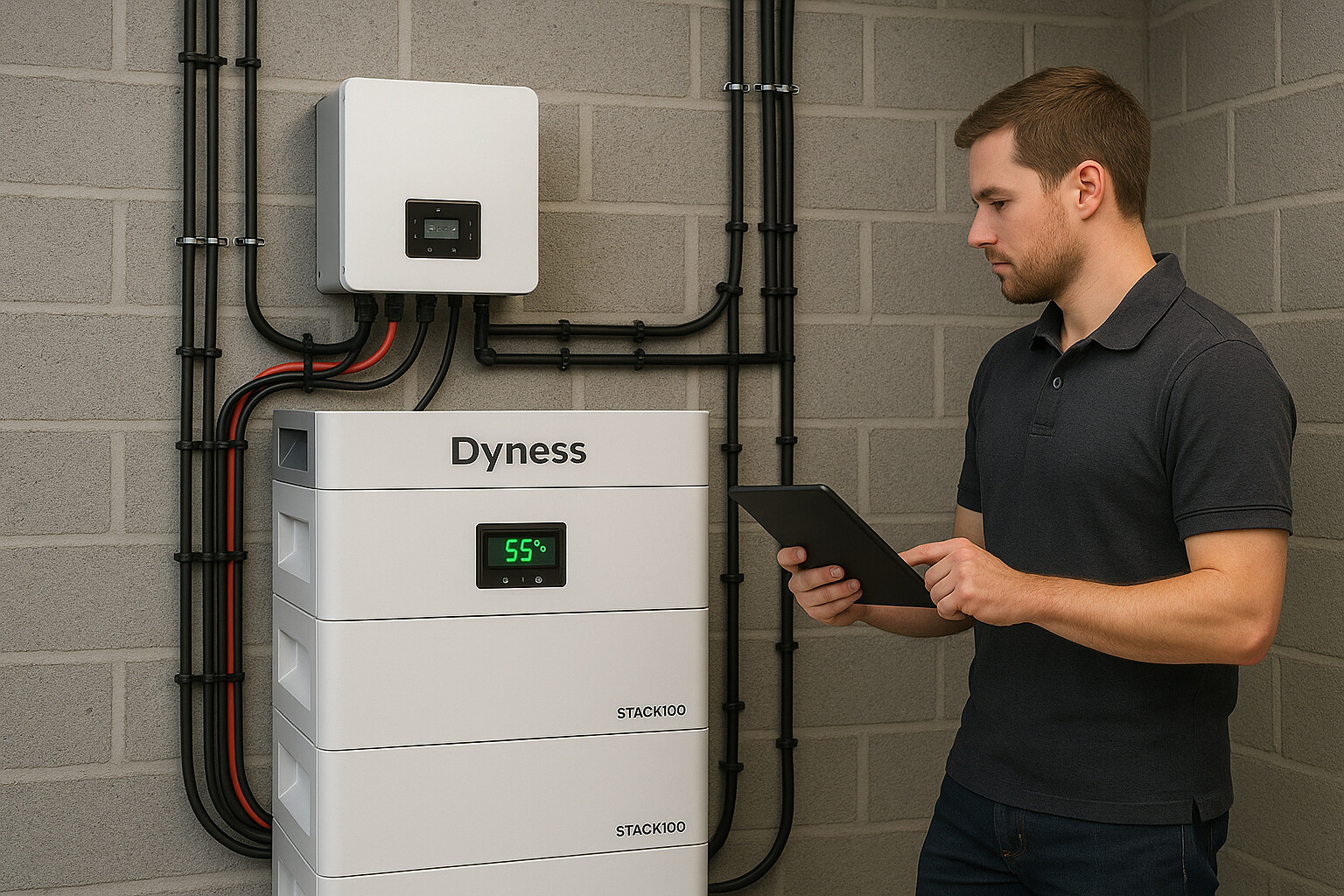
Photovoltaic systems only supply electricity when the sun is shining. To be able to use this energy at night or in bad weather, you need a powerful battery storage system. The Dyness Stack100 with 51.20 kWh offers exactly this solution and is aimed at homeowners, commercial businesses, and industrial users who want to maximize their energy independence.
This Dyness Stack100 test shows you what the modular storage system can do and for which applications it is suitable. The system is based on individual battery modules, each with a capacity of 5.12 kWh, which can be stacked to form larger units. With a total capacity of 51.20 kWh for ten modules, you can easily cover the energy needs of an average single-family home. The lithium iron phosphate technology ensures safety and longevity.
The system is particularly interesting due to its scalability. You can start with a few modules and expand later if your energy requirements increase. This flexibility makes the battery storage system attractive for both private households and larger applications.
What is the Dyness Stack100 Battery Storage System?
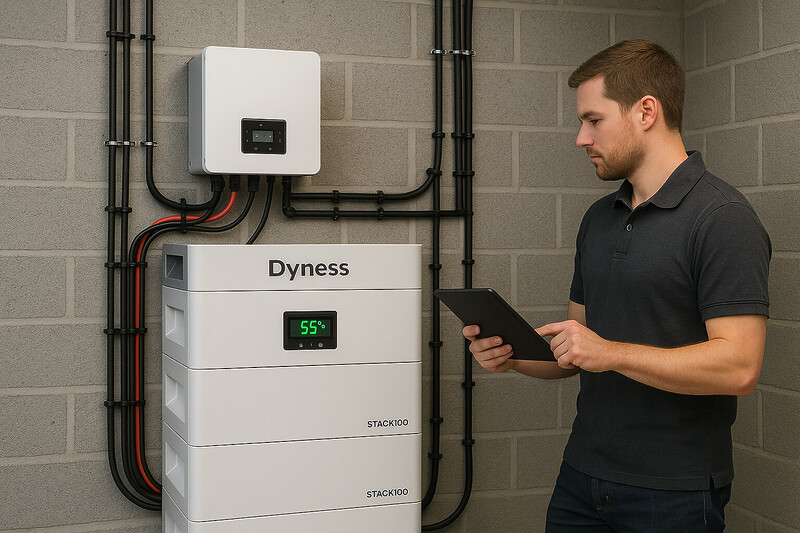
This battery storage system is a modular energy storage system that stores surplus solar power and makes it available again when needed. Each individual module operates with a capacity of 5.12 kWh and can be combined with other units to form a powerful storage tower. The stackable design enables space-saving installation and significantly simplifies later expansions.
The system is based on lithium iron phosphate technology, also known as LiFePO4. This cell technology is characterized by particular stability and safety. In contrast to other lithium-ion batteries, LiFePO4 cells are significantly less prone to thermal problems. In addition, they offer a longer service life and largely retain their capacity even with frequent charging cycles.
The storage system is suitable for private households with photovoltaic systems as well as for commercial businesses with higher energy consumption. Agricultural businesses benefit from the ability to store large amounts of solar power and use it for machinery or stables. Industrial users appreciate the scalability of the system, which can be expanded into the megawatt range.
Technical Data at a Glance
Each battery module operates with a nominal voltage of 51.2 volts DC and offers 5.12 kWh of usable capacity. The maximum charge and discharge current is 100 amperes, which corresponds to a 1C rate. This specification allows the battery to be fully charged or discharged within one hour. The compact dimensions of 590 × 390 × 133.5 millimeters per module facilitate installation even in confined spaces.
| Technical Property | Value |
|---|---|
| Capacity per module | 5.12 kWh |
| Nominal voltage | 51.2 V DC |
| Max. charge/discharge current | 100 A (1C) |
| Dimensions | 590 × 390 × 133.5 mm |
| Weight per module | 47 kg |
| Protection class | IP20 |
| Deep discharge protection | 95% DoD |
➡ Dyness Stack100 with 51.20 kWh in the PV-24 Shop
Weighing 47 kilograms per unit, each module can still be handled by two people. The integrated carrying handles on the sides simplify transport and stacking. The integrated Battery Management System (BMS) BDU controls and monitors all modules. Communication takes place via CAN bus or RS485 interface, while an integrated WiFi module enables remote monitoring and over-the-air updates.
Dyness Stack100 Review: Assembly and Installation
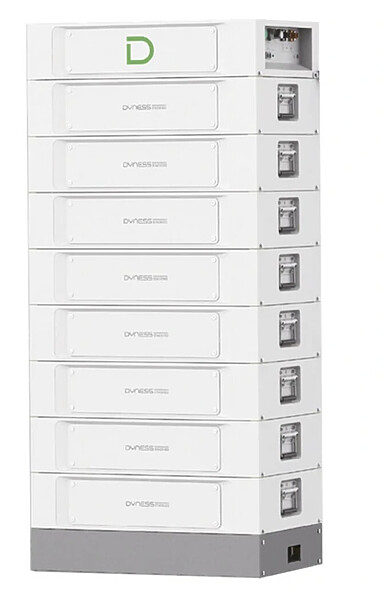
The system assembly is surprisingly straightforward. First, you place the base plate at the designated location and firmly screw it to the ground. Then, you stack the individual battery modules on top of each other. Massive locking bolts ensure that each module is precisely positioned and that the tower stands stably even at greater heights.
Between the modules are plug contacts that connect automatically when stacked. You do not need additional cables between the individual battery units, which significantly reduces installation effort. After stacking, you secure each module with four locking screws to prevent slipping. Finally, you place the BDU control unit as the topmost component on the tower.
Scope of delivery per module:
- Battery module with 5.12 kWh
- Four locking screws
- Desiccant
- Warranty documents and registration instructions
The connection to the inverter is made via standardized Amphenol plug connections for positive and negative, as well as a separate data cable. The time required for installing a complete tower is approximately two to three hours. The system works with various inverters, including models from Goodwe, Solis, Deye, Growatt, and other manufacturers.
Safety Features in Review
Safety is paramount for battery storage systems. Each module has an integrated CO2 extinguishing cartridge that automatically triggers in an emergency. This fire extinguishing system is still rare in battery storage systems for private use and significantly increases the level of safety. The cartridge activates in case of unusual temperature increases and can suppress a fire in its incipient phase.
Active thermal management continuously monitors the temperature of all cells. Fans ensure uniform cooling and keep the operating temperature in the optimal range. A constant temperature not only extends the lifespan of the cells but also prevents critical overheating. The BMS automatically shuts down at limit values, protecting against overcharging, deep discharge, and short circuits.

Matthias Schiestl and his team are always ready to help you reliably and quickly with any questions and with how you can use the devices reliably and efficiently in your everyday life. » learn more about us
+43 676 88731200 9 AM - 12 PM weekdays info@pv-24.at
LiFePO4 cells are generally considered very safe and are hardly prone to what is known as thermal runaway. In this effect, a cell would uncontrollably overheat and cause neighboring cells to overheat as well. The iron phosphate chemistry proves to be significantly more stable here than other lithium technologies. Together with the active safety systems, the storage unit achieves a high level of protection for daily operation.
Dyness Stack100 Review: Performance and Scalability
Scalability is one of the greatest strengths of this system. You can stack up to 15 modules to form a tower with 76.8 kWh capacity. If you need even more storage capacity, up to 12 such towers can be connected in parallel. Theoretically, this allows you to achieve over 920 kWh total capacity, which is sufficient even for larger commercial enterprises.
Typical Application Scenarios:
- Single-family house with heat pump: 40-50 kWh (8-10 modules)
- Single-family house with electric car: 50-60 kWh (10-12 modules)
- Agricultural operation: 70-150 kWh (1-2 towers)
- Commercial operation: 150-500 kWh (2-7 towers)
- Industrial application: up to over 920 kWh (up to 12 towers)
The 1C discharge rate allows for quick retrieval of stored energy. With ten modules and a total capacity of 51.2 kWh, you can theoretically draw over 50 kW continuously. This power is sufficient for most household applications and also for commercial consumers. The longevity of the LiFePO4 cells promises many thousands of charging cycles with minimal capacity loss.
Warranty and Services
The manufacturer’s warranty extends for ten years from the date of installation or a maximum of 180 days after shipment. Within this period, the manufacturer guarantees unlimited charging cycles, which is unusually generous for a battery storage system. The capacity warranty states that at least 70 percent of the original nominal capacity must still be available after ten years.
| Warranty Terms | Details |
|---|---|
| Warranty Period | 10 years from installation (max. 180 days after shipping) |
| Number of Cycles | Unlimited within the warranty period |
| Capacity Warranty | At least 70% after 10 years |
| Registration | Required via website or app |
| Limitation | 3 years for mobile applications or without communication |
Registration via the manufacturer’s website or the associated app is essential for the warranty to be valid. Without this registration, the warranty claim will be completely forfeited. Therefore, please complete the registration immediately after installation and keep the confirmation carefully. The app also allows you to monitor your system and notifies you of any irregularities.
➡ Buy Dyness Stack100 with 51.20 kWh now
Price-Performance Ratio
The costs for battery storage have decreased significantly in recent years. For this system, prices range from approximately 200 euros net per kilowatt-hour, depending on size and configuration. For a complete set with 51.2 kWh capacity, you should therefore calculate around 10,000 euros plus VAT and installation. This pricing is in the lower to middle market segment.
Comparing different systems, the advantageous price-performance ratio becomes particularly evident with larger capacities. While smaller storage units are often proportionally more expensive, this modular design allows you to benefit from economies of scale. The investment pays for itself through saved electricity costs and the ability to achieve greater self-consumption. As grid electricity prices rise, the amortization period shortens accordingly.
When considering economic efficiency, also take into account the long warranty period and the expected lifespan of 15 to 20 years. If you convert the costs to the service life, values of less than 1,000 euros per year result for a large system. For commercial enterprises and agricultural users, additional benefits arise from peak load management and emergency power capability.
Dyness Stack100 Review – Conclusion
The modular battery storage system impresses with its flexibility and scalability. You can start with a basic setup and expand it at any time as your needs increase. The lithium iron phosphate technology offers a high degree of safety and durability. Particularly noteworthy are the integrated fire extinguishing system and active thermal management, which together achieve an above-average level of safety.
Strengths at a glance:
- High scalability from 5.12 kWh to over 920 kWh
- Integrated fire suppression system in each module
- Easy installation thanks to plug-and-stack principle
- Attractive price-performance ratio
- 10-year warranty with unlimited cycles
Installation is relatively easy thanks to the stackable design and integrated connectors. Compatibility with various inverters allows integration into existing photovoltaic systems. There are limitations with protection class IP20, which requires installation in dry indoor areas. The system is recommended for homeowners with higher energy demands, commercial businesses, and agricultural users.
Do you need support with planning?
The selection and dimensioning of a battery storage system require expert knowledge. Factors such as your average electricity consumption, the output of your photovoltaic system, and your individual usage habits influence the optimal system size. An undersized battery will not fully exploit its potential, while an oversized system will incur unnecessarily high investment costs.
Our team will be happy to advise you on selecting the right storage system for your requirements. A detailed consumption analysis forms the basis for correct dimensioning. Also consider future developments such as the possible purchase of an electric vehicle or the installation of a heat pump.
The combination of qualified advice, professional installation, and a powerful storage system like the one presented here maximizes your energy independence and reduces your electricity costs in the long term. This Dyness Stack100 review has shown that the system represents an interesting option both technically and economically for a wide range of applications. Contact us for an individual offer or detailed consultation on your photovoltaic and storage solution.