









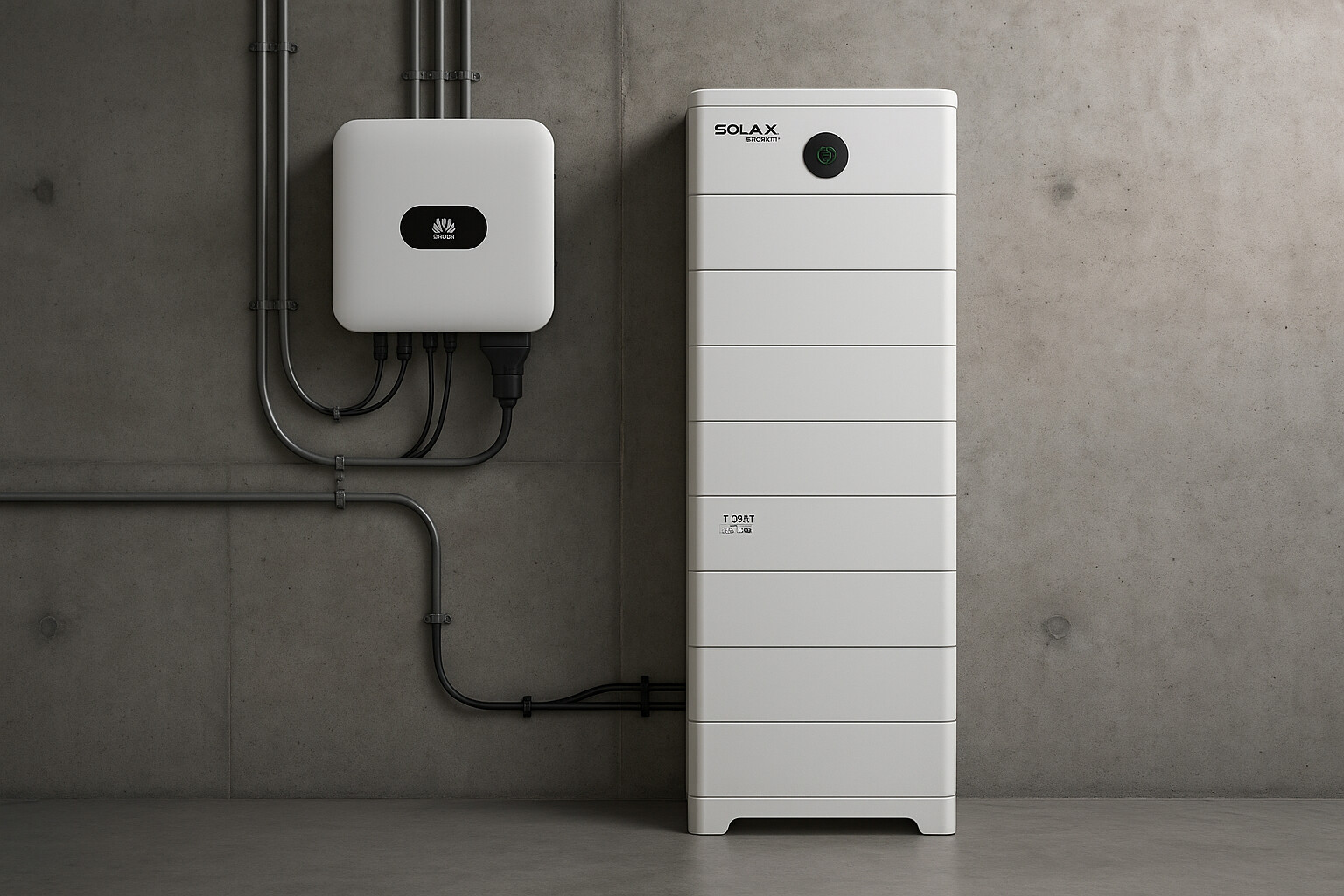
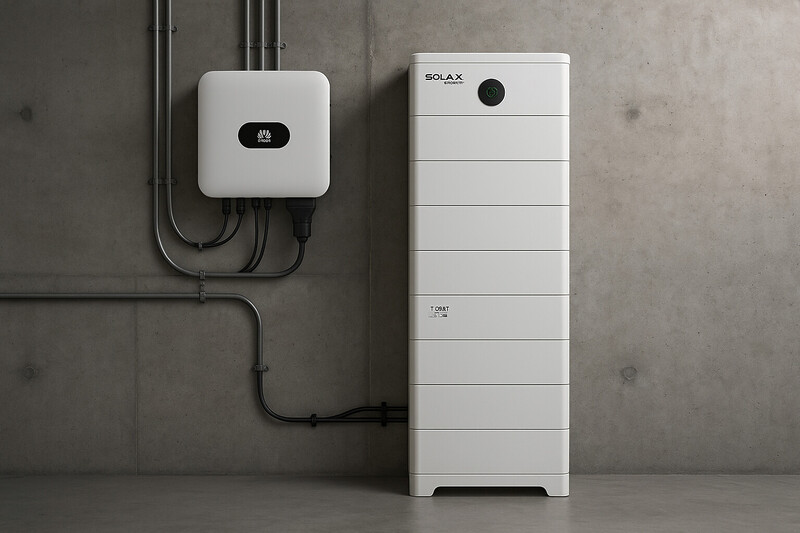
The energy transition is making great strides, and electricity storage plays a central role in this. The SolaX Power T-BAT SYS HS 20.0 HS25 Storage Set positions itself as a flexible solution for modern photovoltaic systems. With 18.4 kWh of usable capacity, this system is aimed at households that want to efficiently store their self-generated solar power.
The high-voltage storage unit from the T-BAT SYS-HV-S series combines modular design with sophisticated technology. Particularly interesting: the wireless stackable design allows for an installation that can also be expanded indefinitely. Whether for the new construction of a solar system or the retrofitting of existing systems – the storage unit offers various application possibilities.
In this detailed test, we examine all relevant aspects of the system. You will learn about the technical characteristics that distinguish the storage set, how the performance data prove themselves in practice, and for which applications the investment is worthwhile. We also shed light on the interaction with compatible inverters and provide you with a sound basis for decision-making.
What is the SolaX Power T-BAT SYS HS 20.0 HS25 Storage Set?
The SolaX Power T-BAT SYS HS 20.0 HS25 Storage Set belongs to the latest generation of high-voltage electricity storage units. These battery systems operate at higher voltages than conventional low-voltage storage units and thus achieve better efficiencies. The reason lies in the smaller voltage difference between solar modules and the battery, which results in fewer conversion losses.
The modular design allows for 2 to 13 battery modules per unit. The system is based on lithium iron phosphate (LFP) cells, which are known for their robustness and long lifespan. With a nominal voltage of 409.6 volts, the storage unit operates in the high-voltage range, which increases the efficiency of the overall system.
The storage set is primarily aimed at operators of photovoltaic systems who are looking for a reliable storage solution. Compatibility with the X3-Ultra Hybrids (15 to 30 kW) makes it particularly interesting for larger systems. However, smaller systems also benefit from the technology. The IP65 protection class allows for flexible installation locations – from the basement to the garage.
➡ SolaX Power T-BAT SYS HS 20.0 HS25 Storage Set in the PV-24 Shop
Technical Characteristics at a Glance
Capacity and Performance Data
The usable battery capacity of 18.4 kWh forms the core of the system. This value describes the actually available amount of energy, not the theoretical total capacity. The difference between gross and net capacity protects the battery from deep discharge and significantly extends its lifespan.
Particularly noteworthy is the almost unlimited expandability. You can add additional modules to the system at any time, without having to observe any time restrictions. Up to 13 battery modules can be installed per unit, allowing for a maximum capacity of 29.9 kWh. This flexibility allows the storage unit to be adapted to increasing energy demands.
Performance data varies depending on the expansion stage:
| Expansion Stage | Usable Capacity | Rated Power | Maximum Power |
|---|---|---|---|
| Minimum | 2.3 kWh | 2.5 kW | ~3.0 kW |
| Small | 5.5 kWh | 5.1 kW | ~6.2 kW |
| Medium | 8.3 kWh | 7.6 kW | ~9.2 kW |
| Tested | 18.4 kWh | 10.2 kW | 12.3 kW |
| Maximum | 29.9 kWh | ~15 kW | ~18 kW |
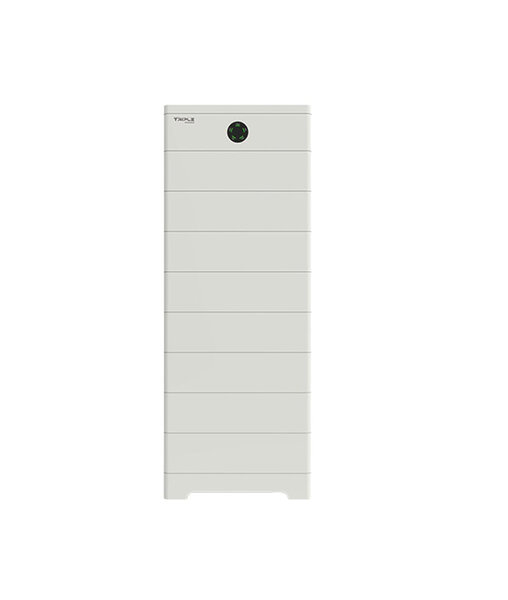
Battery Specifications
The LFP (Lithium Iron Phosphate) cell chemistry used is considered particularly safe and durable. Unlike other lithium-ion technologies, LFP does not tend to overheat and shows stable performance values even after many charging cycles. The cells achieve 6,000 full cycles at 90 percent residual capacity – a value that corresponds to approximately 27 years of operation with average use.
Key Technical Data in Detail:
- Cell Chemistry: Lithium Iron Phosphate (LFP)
- Nominal Voltage: 409.6 V
- Protection class: IP65 (dust-tight & jet-proof)
- Dimensions: 1,323 x 510 x 365 mm (H x W x D)
- Weight of storage module: approx. 28 kg per module
- Weight of BMS: 10 kg
- Total weight (8 modules): approx. 234 kg
The IP65 protection class deserves special attention. The first digit (6) stands for complete protection against dust, the second (5) for protection against water jets from all directions. This classification allows installations even in less protected areas such as garages or carports, where temperature and humidity fluctuate more significantly.
SolaX Power T-BAT Test: Performance Features
Charge and Discharge Power
With full equipment, the nominal power reaches an impressive 10.2 kW. This value describes how quickly the battery can be charged or discharged. For photovoltaic systems, high charging power means that even on days with only a few hours of sunshine, the storage unit fills efficiently. The high discharge power ensures that even power-intensive consumers are supplied without problems.
An important characteristic value is the C-rate, which describes the relationship between capacity and power. The SolaX Power T BAT Test system achieves a C-rate of approximately 1.0. This means that a storage unit with 10 kWh capacity can be charged or discharged with 10 kW. This 1C-rate theoretically allows a complete charge or discharge in one hour – an excellent value compared to other systems.
Performance comparison of typical household consumers:
- Hotplate (old): 1.5 – 2 kW
- Complete electric stove: 4 – 6 kW
- Heat pump: 2 – 6 kW
- Electric car wallbox: 11 kW
- Instantaneous water heater: 18 – 27 kW
- SolaX T-BAT peak power: 12.3 kW
The maximum power output even briefly exceeds the nominal power. The system can absorb power peaks when large consumers such as heat pumps or electric motors start up.
Efficiency and Degree of Efficiency
The battery efficiency is a solid 95 percent. This means that for every 100 kWh of energy fed in, 95 kWh are available for retrieval. The remaining 5 percent are lost as heat – a physically unavoidable process. The SolaX T BAT test shows that this value is quite competitive compared to the industry average.
However, you should consider the system losses holistically. The inverter adds another 2 to 5 percent in losses, depending on the load and operating mode. Additional losses occur during the conversion of direct current (DC) from the solar modules into alternating current (AC) for household consumption.
Efficiency Chain at a Glance:
| Component | Efficiency | Loss |
|---|---|---|
| Solar modules → Battery (DC-DC) | ~97% | 3% |
| Battery (storage) | ~95% | 5% |
| Battery → Household (DC-AC) | ~96% | 4% |
| Overall system | ~88-92% | 8-12% |
Compared to other storage systems, the SolaX system ranks in the upper mid-range. High-voltage storage units like this are fundamentally more efficient than low-voltage counterparts. The smaller voltage difference between the solar system and the battery significantly reduces conversion losses.
➡ Buy SolaX Power T-BAT SYS HS 20.0 HS25 Storage Set now
SolaX T BAT Test: Installation and Setup
The wireless stackable design revolutionizes the installation of battery storage systems. Instead of complex wiring between individual modules, they are simply stacked on top of each other. Contact is made via integrated plug connections that automatically connect during assembly. This system not only saves time but also minimizes potential sources of error.
Installers report significantly reduced assembly times. A complete system can be put into operation within a few hours. The plug-and-play philosophy is also evident during commissioning: after mechanical assembly, configuration is carried out via the inverter. Updates and diagnostics also run through this central interface, which simplifies maintenance.
Installation advantages at a glance:
- Wireless connections between modules
- Plug-and-play installation in a few hours
- Updates and diagnostics via inverter
- Unlimited expandability
- IP65 protection for flexible locations
- Operating temperature: -30°C to +50°C
- Recommended environment: -20°C to +50°C
The IP65 protection class opens up flexible installation options. You can install the storage unit in basements where there is high humidity. Installation in unheated garages or under carports is also possible.
Compatibility and Integration
Interaction with inverters
The SolaX HS25 Storage Set Experience shows particularly good coordination with the X3-Ultra hybrid inverters. These latest generation devices offer power classes from 15 to 30 kW and are specially designed for high storage capacity. The ampere values of the inverter and battery harmonize perfectly: with 25 amperes on both sides, energy flows without bottlenecks.
However, smaller systems also benefit from the storage unit. Compatibility extends to earlier inverter generations with lower power. A 5 kW system can be operated just as well as a 12 kW system. This flexibility makes the storage set interesting for retrofitting existing photovoltaic systems.
Compatible Inverter Configurations:
| Inverter | Max. PV capacity | Battery recommendation | Application area |
|---|---|---|---|
| X3-Hybrid 5.0 | 10 kWp | 5.5 – 8.3 kWh | Single-family home |
| X3-Hybrid 8.0 | 16 kWp | 8.3 – 11 kWh | Large household |
| X3-Hybrid 10.0 | 20 kWp | 11 – 18.4 kWh | High consumption |
| X3-Ultra 15.0 | 30 kWp | 18.4 – 29.9 kWh | Commercial/Agriculture |
An optimal system configuration takes several factors into account. The storage capacity should match the daily power consumption – as a rule of thumb, approximately 1.5 times the daily requirement.

Matthias Schiestl and his team are always ready to help you reliably and quickly with any questions and with how you can use the devices reliably and efficiently in your everyday life. » learn more about us
+43 676 88731200 9 AM - 12 PM weekdays info@pv-24.at
Emergency Power Function
Emergency power capability is one of the most important functions of modern storage systems. In the event of a power outage, the storage unit switches to island mode within less than 10 milliseconds. This extremely short switching time is well below the perception threshold – computers continue to run, refrigerators do not interrupt their operation.
In emergency power mode, the system provides between 5 and 15 kW of power, depending on the inverter size. This three-phase supply powers the entire house, not just individual circuits. For comparison: a hotplate requires about 2 kW, an electric car when charging 11 kW, a heat pump between 2 and 6 kW. With 15 kW of emergency power, you can cover even demanding consumption scenarios.
Emergency Power Equipment in Detail:
- Switching time: < 10 milliseconds
- Supply type: Three-phase (all phases)
- Emergency power output: 5 – 15 kW (depending on inverter)
- Unbalanced loads: Partially compensable
- Starting currents: Higher peaks possible
- Autonomy duration: Dependent on consumption & capacity
Practical application scenarios illustrate the benefits. In the event of a power outage lasting several hours in winter, the storage unit supplies heating, lighting, and refrigeration appliances. In summer, it enables the continued operation of air conditioning and office equipment.
Lifespan and Warranty
The promised 6,000 full cycles at 90 percent remaining capacity represent a solid value. A full cycle corresponds to a complete charge and discharge of the storage unit. With an average of 200 to 250 cycles per year – realistic for a well-dimensioned storage unit – a service life of 24 to 30 years can be calculated. This period significantly exceeds the usual warranty period.
The manufacturer’s warranty covers 10 years or these 6,000 cycles, whichever comes first. After this period, the manufacturer still guarantees at least 90 percent of the original capacity. For comparison: some competitors offer a 15-year warranty but set the limit at 70 percent remaining capacity.
Lifespan Calculation:
| Parameter | Value | Calculation |
|---|---|---|
| Guaranteed cycles | 6,000 | At 90% remaining capacity |
| Cycles per year | 200-250 | Average usage |
| Calculated lifespan | 24-30 years | 6,000 ÷ 200-250 |
| Warranty period | 10 years | Or 6,000 cycles |
| Remaining capacity guaranteed | 90% | After the end of the warranty |
In practice, LFP cells demonstrate excellent aging resistance. Calendar aging – the capacity loss due to mere storage – is low with this technology. The integrated Battery Management System automatically controls these parameters for maximum lifespan.
SolaX HS25 Storage Set Experiences: Operating Conditions
The temperature range of -30°C to +50°C for charging and discharging processes surpasses many competitor systems. This specification enables operation under extreme climatic conditions. However, the battery operates with reduced performance at very low or high temperatures – a protective mechanism that prevents damage to the cells.
For the ambient temperature, the manufacturer recommends a range between -20°C and +50°C. Above 45°C, the system automatically throttles performance to prevent overheating. This point deserves attention when choosing a location: an uninsulated attic can reach critical temperatures in midsummer.
Optimal Installation Locations in Comparison:
| Location | Temperature | Humidity | Suitability | Note |
|---|---|---|---|---|
| Dry basement | ★★★★★ | ★★★★★ | Optimal | Best choice |
| Heating basement | ★★★★☆ | ★★★★☆ | Very good | Watch out for heat |
| Garage (heated) | ★★★★☆ | ★★★★☆ | Very good | Good alternative |
| Garage (unheated) | ★★★☆☆ | ★★★☆☆ | Good | Check winter operation |
| Carport/Outdoors | ★★☆☆☆ | ★★☆☆☆ | Conditional | Only with IP65 |
| Attic | ★☆☆☆☆ | ★★★☆☆ | Not recommended | Summer heat critical |
Thanks to IP65 protection, humidity plays a minor role. Theoretically, the system can withstand 100 percent relative humidity without damage. Nevertheless, you should avoid locations with permanently high humidity – not because of the battery itself, but because of the connection technology.
➡ SolaX Power T-BAT SYS HS 20.0 HS25 Storage Set from PV-24
Price-Performance Ratio
The cost factor per kWh of usable capacity is in the lower market segment. Complete sets with 18.4 kWh storage, inverter, and accessories are priced significantly below many established brands. If you break down the costs to individual kilowatt-hours, values between 400 and 600 Euros per kWh result – depending on the chosen expansion stage and the dealer.
Larger storage configurations further reduce specific costs. With maximum equipment of almost 30 kWh usable capacity, the price per kWh drops to approximately 350 to 450 Euros. These economies of scale make larger systems more economically attractive, provided that the energy demand justifies the capacity.
Price overview of various expansion stages:
| Configuration | Capacity | Approx. system price | Price/kWh | Amortization* |
|---|---|---|---|---|
| Basic system | 5.5 kWh | approx. €3,500 | ~€640/kWh | 10-12 years |
| Mid-range system | 11 kWh | approx. €5,500 | ~€500/kWh | 8-10 years |
| Test system | 18.4 kWh | approx. €8,000 | ~€435/kWh | 7-9 years |
| Large system | 29.9 kWh | approx. €11,500 | ~€385/kWh | 7-9 years |
*At €0.30/kWh electricity price and 70% self-consumption
Compared to competitor products, the system positions itself as a price-performance winner. Premium manufacturers sometimes charge double for comparable capacities. The higher price buys additional features such as sophisticated energy management systems or longer warranties.
Who is the SolaX Power T BAT Storage Set suitable for?
Ideal Use Cases
For new photovoltaic installations, the system offers a cost-effective complete solution. The coordination between inverter and storage is carried out ex works, which eliminates compatibility problems. The modular design makes it possible to start with a smaller capacity and expand later as needed. This flexibility saves budget on the initial investment.
Retrofitting existing systems is also straightforward. Older systems without storage can be upgraded with the T-BAT system, thereby achieving higher degrees of self-sufficiency. Compatibility with various inverter generations facilitates integration. However, you should check whether your existing inverter supports high-voltage technology.
Perfectly suited for:
- New build projects with a focus on cost-effectiveness
- Retrofitting existing PV systems
- Households with 4,000-8,000 kWh annual consumption
- Operators with high-power consumers
- Users with emergency power requirements
- Expandable systems for growing needs
- Price-conscious buyers without premium demands
Performance-oriented users appreciate the high C-rate and emergency power capability. Households with power-intensive consumers such as heat pumps, electric car wallboxes, or large air conditioning systems benefit from the powerful discharge capacity.
Limitations and Alternatives
The limitations in energy management are currently significant. Unlike premium systems, the storage unit does not offer integrated control for dynamic electricity tariffs or sector coupling. The intelligent integration of heat pumps, electric cars, and household batteries requires external solutions. Systems like Clever PV or smartfox can be retrofitted, but they incur additional costs and increase system complexity.
You should not disregard data protection considerations. As with many IoT devices, this storage unit also communicates with cloud services. Data transfer to foreign servers can raise data protection concerns. Those who demand the highest standards of data sovereignty should prefer alternative systems with local data processing.
Less suitable for:
- Users with high data protection requirements
- Systems with dynamic electricity tariffs (without external EMS)
- Complex sector coupling (heat pump + electric car)
- Very large storage solutions > 30 kWh (per unit)
- Preference for exclusively domestic manufacturers
- Need for an integrated smart home system
Alternative solutions exist in various price ranges. German manufacturers offer systems with extensive energy management functions and local data storage – however, at significantly higher costs.
Advantages and Disadvantages at a Glance
Advantages:
| Category | Advantage | Rating |
|---|---|---|
| Installation | Wireless stacking design | ★★★★★ |
| Performance | C-rate 1.0 (fast charging/discharging) | ★★★★★ |
| Durability | 6,000 cycles at 90% remaining capacity | ★★★★★ |
| Protection | IP65 for flexible installation locations | ★★★★★ |
| Temperature | -30°C to +50°C operating range | ★★★★★ |
| Emergency power | < 10 ms switchover time, three-phase | ★★★★★ |
| Flexibility | Unlimited scalability | ★★★★★ |
| Price | €400-600/kWh system costs | ★★★★★ |
Disadvantages:
| Category | Disadvantage | Rating |
|---|---|---|
| Energy Management | No integrated EMS | ★★☆☆☆ |
| Smart Features | No dynamic electricity tariffs | ★★☆☆☆ |
| Data Protection | Cloud communication required | ★★★☆☆ |
| Origin | No local production | ★★★☆☆ |
| Capacity | Max. 30 kWh per unit | ★★★★☆ |
Conclusion
The SolaX Power T-BAT SYS HS 20.0 HS25 storage set is recommended for price-conscious buyers looking for solid storage technology without premium features. The combination of 18.4 kWh usable capacity, high performance, and robust LFP technology proves convincing in practice. The quick installation and flexible expandability are particular advantages of the system.
Your specific needs should be decisive for your purchase. Do you operate a medium-sized photovoltaic system and value emergency power capability? Then this system offers excellent performance at a fair price. If, however, you are planning comprehensive home automation with a heat pump, electric car, and dynamic electricity tariffs, then you should invest in more expensive systems with integrated energy management.
Our test verdict:
| Criterion | Rating | Points |
|---|---|---|
| Value for money | ★★★★★ | 10/10 |
| Technical data | ★★★★★ | 9/10 |
| Installation | ★★★★★ | 10/10 |
| Performance | ★★★★★ | 9/10 |
| Emergency power | ★★★★★ | 9/10 |
| Smart features | ★★☆☆☆ | 4/10 |
| Expandability | ★★★★★ | 10/10 |
| Overall | ★★★★☆ | 8.7/10 |
The technical specifications deliver on their promises. Practical experience with the SolaX HS25 storage set confirms its reliability and performance. At pv-24.at, you will find the complete range as well as expert advice for your individual configuration. Compare different expansion stages and check available funding. With the correct dimensioning and professional installation, you will receive a storage system that reliably provides your self-generated solar power for decades.