









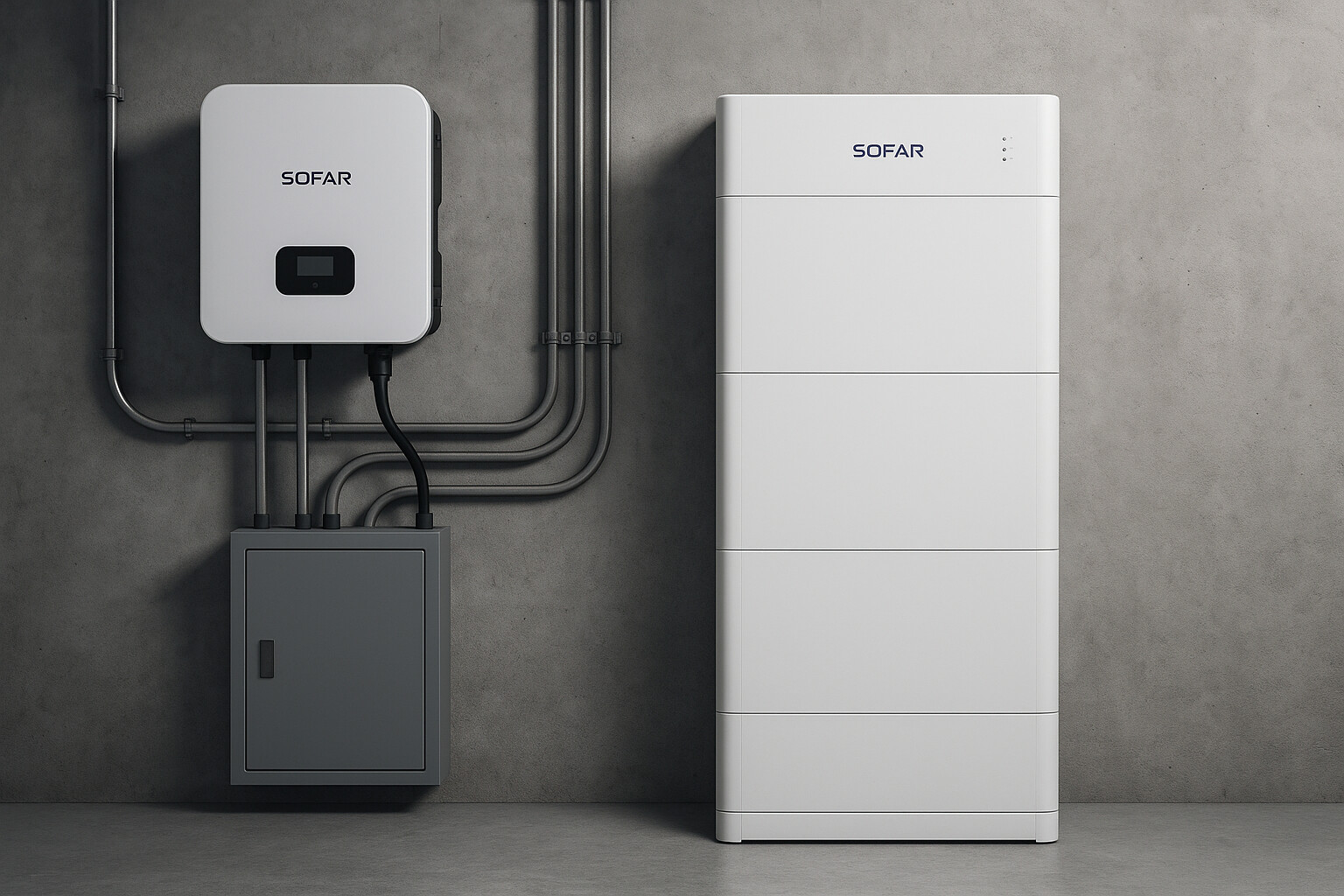
The storage of self-generated solar energy is becoming increasingly important for homeowners. Photovoltaic systems primarily supply electricity at midday, while demand is often highest in the morning and evening. A powerful battery storage system closes this time gap and significantly increases self-consumption. The SofarSolar BTS E15-D5 storage system offers a flexible solution with 14.25 kWh of usable capacity.
This article examines the modular high-voltage system from various perspectives. You will learn about the technical structure of the system and its everyday functions. Practical SofarSolar BTS E15-D5 storage system experiences show its strengths and what aspects you should consider before making a purchase decision. Both installation and long-term operation are discussed.
The following sections first explain the basics of the system, before detailed technical information and practical experiences follow. Finally, an assessment helps to evaluate whether the investment is worthwhile for your individual needs.
What is the SofarSolar BTS E15-D5 Storage System?
This product is a high-voltage battery storage system specifically designed for combination with hybrid inverters. The system operates with a nominal voltage of 400 volts and uses lithium iron phosphate cells as energy storage. This technology is characterized by a long service life and high safety standards. The modular design allows for flexible adaptation to different requirements.
Ideal Applications:
- Private homes with 10-20 kWh daily demand
- Single-family homes with heat pump or electric vehicle
- Smaller commercial businesses with constant base consumption
- Properties with limited space
Compatibility is limited to specific inverter series from the same manufacturer. This coordination ensures optimal communication between components and simplifies system integration. For operators, this means uniform control of all elements via a central interface, which reduces sources of error and facilitates maintenance.
➡ SofarSolar BTS E15-D5 Storage System in the PV-24 Shop
Technical Specifications and Features at a Glance
Capacity and Performance Features
The usable storage capacity is 14.25 kilowatt-hours, which provides sufficient energy for an average household overnight. This figure refers to the actually available energy that you can draw from the system. The nominal voltage is 400 volts, typical for high-voltage systems in the private sector. Such voltage values enable higher efficiencies in energy conversion.
| Technical Property | Value |
|---|---|
| Usable Capacity | 14.25 kWh |
| Nominal Voltage | 400 V |
| Cell Chemistry | LFP (Lithium Iron Phosphate) |
| Max. Modules (small inverter) | 4 units (~19 kWh) |
| Max. Modules (large inverter) | 8 units (~38 kWh) |
| Efficiency | >95% |
Particularly interesting is the scalability of the concept. Depending on the connected inverter, up to eight battery units can be operated in parallel. This allows you to achieve a maximum total capacity of over 38 kilowatt-hours, which is sufficient even for larger properties or commercial applications. Expansion can be carried out at any time retrospectively, without having to replace the existing system. Each battery module has an integrated battery management system that individually monitors cell voltage, temperature, and charge status.
Construction and Installation
The modular design consists of several stacked units mounted on a base unit. Each storage module measures 1520 millimeters in height, 708 millimeters in width, and only 170 millimeters in depth. This flat design allows for wall mounting even in rooms with limited floor space. Basements, utility rooms, or garages usually offer sufficient space.
Dimensions and Weight:
- Height: 1,520 mm
- Width: 708 mm
- Depth: 170 mm (particularly space-saving!)
- Weight of base unit: approx. 7.5 kg
- Weight per module: approx. 50 kg
- Total weight of basic configuration: ~157.5 kg
The IP65 protection class theoretically also allows installation in outdoor areas or rooms with higher humidity. Protection against dust and jet water is guaranteed. Nevertheless, a dry, frost-free installation location is recommended for optimal service life. Extreme temperature fluctuations affect battery chemistry and should be avoided to maintain performance in the long term.

SofarSolar BTS 5K Test: Functionality in Practice
The core is the battery management system, which operates independently in each unit. It continuously monitors all relevant parameters such as cell voltage, current, and temperature. In case of overload or critical values, the control system intervenes immediately and limits charging or discharging power. This decentralized intelligence ensures that individual modules are optimized independently of each other.
Energy Flow Throughout the Day:
- Morning (6-10 AM): Storage supplies household appliances, PV system starts production
- Midday (10 AM-4 PM): Surplus solar power charges battery, direct consumption has priority
- Evening (4 PM – 10 PM): Storage takes over supply, grid power remains as reserve
- Night (10 PM – 6 AM): Complete supply from battery until discharge limit
The Sofar Solar BTS 5K test shows that charging efficiency is over 95 percent, which is typical for modern systems. Discharge processes occur in reverse: when electricity is needed, the storage unit releases energy to household appliances before grid power is drawn. Integration into the home network is done via the hybrid inverter, which acts as a central control unit. Through an app or web interface, you can monitor all energy flows and program charging strategies individually.
➡ Buy SofarSolar BTS E15-D5 storage system directly
SofarSolar BTS Experience: Advantages of the System
The option for gradual capacity expansion is one of the biggest advantages. Initially, you only install the required storage size and can upgrade later if demand increases. This flexibility saves budget and prevents oversized systems. Practical experience shows that many users start with two modules and expand later.
Core advantages at a glance:
- Modular Expandability: Gradual adaptation to growing energy demand possible
- Compact Design: Only 17 cm deep – ideal for confined spaces
- LFP Technology: 4,000-6,000 charging cycles, higher safety than NMC cells
- Decentralized BMS: Each module with its own management for optimal cell balancing
- IP65 Protection: Protected against dust and jet water
- Unified System: All components from one manufacturer for perfect coordination
The SofarSolar BTS experience of many operators confirms that the storage units still deliver almost full performance even after years. In addition, there is increased safety, as lithium iron phosphate cells are more thermally stable and have a lower risk of fire. The uniform design looks tidy and blends visually into basement rooms, while valuable floor space remains free.
Disadvantages and Limitations
The commitment to inverters from the same manufacturer limits flexibility. If you already operate a system from another provider, you may have to replace it or cannot use the storage unit. You should consider this dependency during planning, especially if future expansions are pending. Alternative systems sometimes offer more compatibility with various inverters.
Critical Aspects in Evaluation:

Matthias Schiestl and his team are always ready to help you reliably and quickly with any questions and with how you can use the devices reliably and efficiently in your everyday life. » learn more about us
+43 676 88731200 9 AM - 12 PM weekdays info@pv-24.at
- Manufacturer Dependency: Only usable with compatible inverters
- Higher Acquisition Costs: Positioned in the mid to upper price segment
- Expansion Limits: Maximum 4-8 modules depending on inverter power
- Installation Effort: Extensions require specialist company involvement
- Amortization Period: 10-15 years at current electricity prices
There are clear upper limits for cascading: smaller inverters support a maximum of four modules, larger ones up to eight. This technical limitation can become a problem with very high energy demand. Commercial businesses with consumption exceeding 40 kilowatt-hours daily will reach these limits. Furthermore, every extension requires intervention by specialist personnel, which incurs additional costs.
SofarSolar BTS 5K Review: Who benefits from the purchase?
Households with three to five people and a daily electricity consumption between 12 and 18 kilowatt-hours benefit the most. At this scale, the basic configuration reliably covers nightly demand and significantly increases the degree of self-sufficiency. Families with electric vehicles or heat pumps should plan for an extension to also power these consumers from the storage system.
| Household size | Daily demand | Recommended configuration | Degree of self-sufficiency |
|---|---|---|---|
| 2 people | 8-12 kWh | 1-2 modules (~14 kWh) | 60-70% |
| 3-4 people | 12-18 kWh | 2-3 modules (~19 kWh) | 65-75% |
| 4-5 people | 18-25 kWh | 3-4 modules (~24 kWh) | 60-70% |
| With heat pump | 25-35 kWh | 5-6 modules (~29 kWh) | 55-65% |
| With e-car | 30-40 kWh | 6-8 modules (~38 kWh) | 50-60% |
Economically, profitability depends heavily on individual electricity prices. The higher the cost of electricity from the grid, the faster the investment pays off. With current tariffs around 35 cents per kilowatt-hour, you can achieve amortization periods of ten to fifteen years. The SofarSolar BTS 5K Review is particularly positive for technically interested operators who value monitoring and optimization. Tax incentives or regional subsidies can significantly shorten the amortization period.
Installation and Commissioning
The installation location should be dry and protected from direct sunlight. Ideal ambient temperatures are between 5 and 30 degrees Celsius, even though the system tolerates a wider range. Basements usually meet these requirements without problems. Ensure adequate air circulation, as small amounts of heat are generated during charging and discharging, which must be dissipated.
Requirements for the installation site:
- Dry, frost-free room (ideal: basement, utility room, garage)
- Temperature range: 5-30°C optimal, 0-40°C tolerable
- Load-bearing wall or stable surface (min. 200 kg load capacity)
- Minimum distance to the wall: 10 cm for air circulation
- Access for maintenance and future expansions
- Proximity to the inverter for short cable runs
Installation absolutely requires a certified electrical specialist with experience in photovoltaics. In addition to mechanical assembly, high-voltage connections must be established and the system integrated into the existing installation. Specialized installers require approximately half to a full working day for the standard configuration. After connection, parametrization is carried out via the system interface, where charging and discharging strategies are defined and communication between the inverter and the storage unit is checked.

Frequently Asked Questions (FAQ)
What is the maximum number of modules that can be combined?
The maximum number depends on the inverter used. Smaller models with 5 to 8 kilowatts of power support up to four battery modules, which corresponds to a total capacity of approximately 19 kilowatt-hours. Larger inverters between 10 and 20 kilowatts allow for the cascading of up to eight units, resulting in over 38 kilowatt-hours of usable storage capacity.
| Inverter type | Max. modules | Max. capacity |
|---|---|---|
| HYD 5-8 kW | 4 units | ~19 kWh |
| HYD 10-20 kW | 8 units | ~38 kWh |
This staggering takes into account the charging and discharging capacity of the inverters. An oversized storage unit would not be fully utilized if the inverter does not provide enough power. The coordination between both components is therefore crucial for optimal system efficiency.
What warranty does the manufacturer offer?
As standard, the manufacturer grants a ten-year product warranty on the battery modules. This warranty covers material and manufacturing defects that lead to malfunctions. In addition, there is a performance warranty that assures at least 70 percent of the initial capacity after ten years. Such values are standard in the industry for modern lithium iron phosphate systems.
Warranty services in detail:
- Product warranty: 10 years on material and workmanship
- Performance warranty: Min. 70% residual capacity after 10 years
- Prerequisite: Professional installation by a certified company
- Important: Registration with the manufacturer required after installation
Therefore, document maintenance and adhere to recommended operating parameters. Improper handling or extreme environmental conditions can void claims.
Is the system eligible for subsidies?
Many federal states and municipalities offer grants for battery storage in conjunction with photovoltaic systems. The amount of funding varies regionally and is often between 200 and 400 euros per kilowatt-hour of storage capacity. Low-interest loans from the Kreditanstalt für Wiederaufbau are also available. These programs change regularly, so it is worth checking for current information before ordering.
Operators can claim tax depreciation if the storage unit is considered operating equipment for a photovoltaic system. Since 2023, for systems up to 30 kilowatts peak, VAT on delivery and installation in Germany and Austria has been waived. This regulation significantly reduces overall costs. Contact us at pv-24.at – we will inform you about current funding opportunities in Austria.
➡ SofarSolar BTS E15-D5 Storage System from PV-24
How long does the storage unit last?
Lithium iron phosphate batteries typically achieve 4,000 to 6,000 full cycles before their capacity drops to 80 percent. For an average household with one cycle per day, this means a lifespan of over ten years with good treatment. Many systems continue to operate reliably even after that, albeit with reduced storage capacity.
Factors for long lifespan:
- Operation within the optimal temperature range (15-25°C)
- Avoidance of deep discharges below 10%
- Regular software updates of the BMS
- Protection against extreme temperature fluctuations
- Moderate charge and discharge rates
The integrated battery management system largely automatically protects against stressful situations. Practical experience often shows longer operating times than stated by the manufacturer, especially with gentle operation.
Can the system be expanded later?
Yes, subsequent expansions are a core feature of the modular concept. You can add more battery modules at any time, as long as the maximum number for your inverter is not exceeded. The new modules are simply stacked onto the existing unit and electrically connected. The battery management system automatically recognizes the additional capacity.
For the expansion, you will again need a specialized company to handle the mechanical and electrical integration. The costs are significantly lower than a new installation, as the inverter and base unit are already in place. Timing does not play a crucial role – retrofitting works smoothly even years after the initial installation. Some operators deliberately wait to stagger the investment or take advantage of price developments.
Conclusion
The SofarSolar BTS E15-D5 storage system positions itself as a flexible solution for private and small commercial photovoltaic systems. Its modular design allows for needs-based sizing and subsequent expansions without changing the system. With 14.25 kilowatt-hours of usable capacity in its basic configuration, it reliably covers the needs of typical households. The lithium iron phosphate technology used is convincing due to its longevity and safety.
Summary of the review:
| Criterion | Rating | Comment |
|---|---|---|
| Capacity | ⭐⭐⭐⭐⭐ | 14.25 kWh usable, expandable up to 38 kWh |
| Modularity | ⭐⭐⭐⭐⭐ | Flexibly expandable, future-proof |
| Technology | ⭐⭐⭐⭐⭐ | LFP cells, long service life |
| Space requirements | ⭐⭐⭐⭐⭐ | Only 17 cm deep, very compact |
| Value for money | ⭐⭐⭐⭐☆ | Mid to upper segment |
| Compatibility | ⭐⭐⭐☆☆ | Only with certain inverters |
The system is particularly recommended for operators who value expandability and already use suitable components. The combination of space-saving design, security, and flexibility makes it a worthwhile option.