









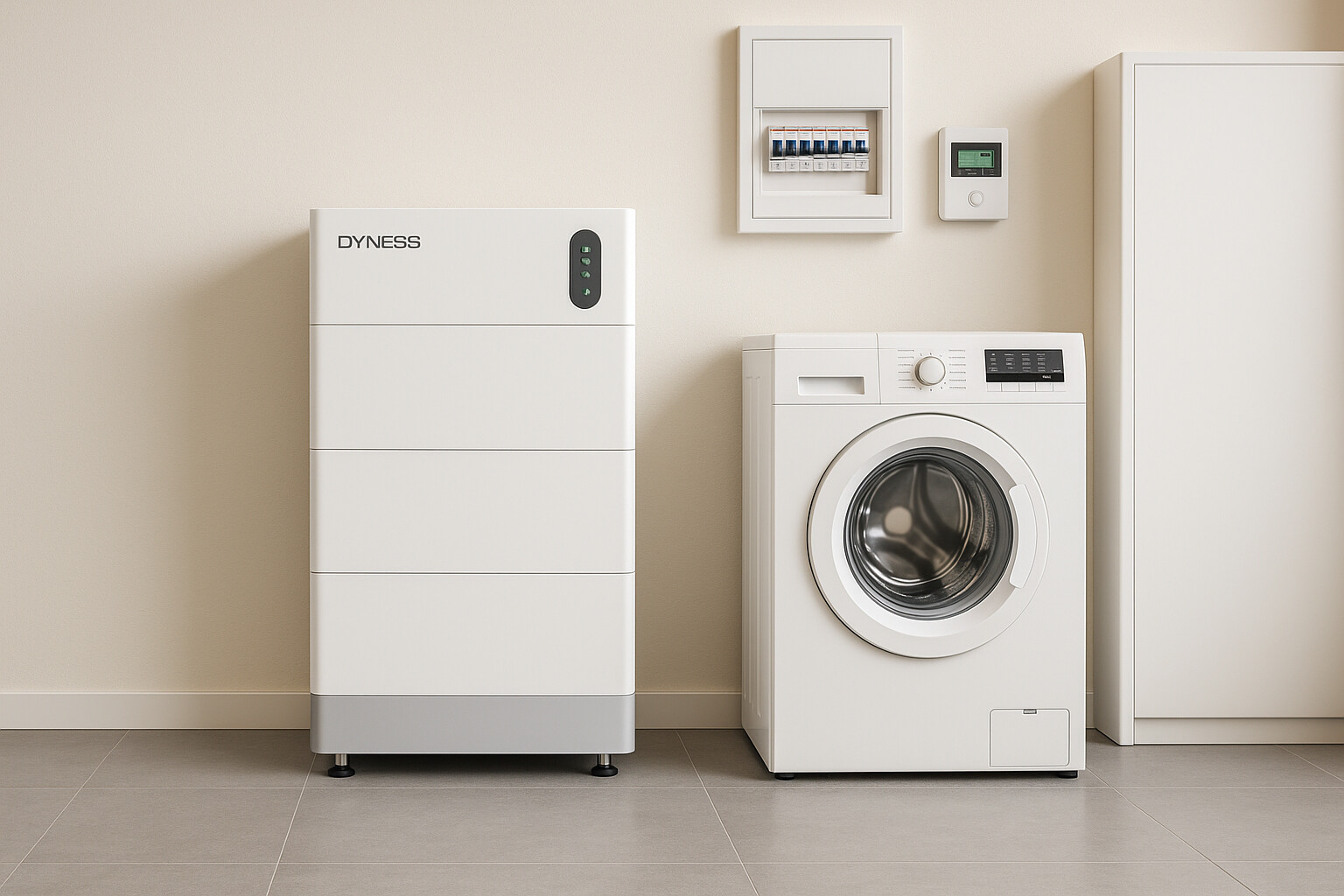
Battery storage systems for photovoltaic installations are becoming increasingly important for the efficient utilization of self-generated solar power. The Dyness Tower Pro TP7 positions itself as a modular high-voltage storage system designed for both private households and small commercial businesses. With a usable capacity of 7.68 kWh, this battery stack provides sufficient energy to largely cover daily electricity needs.
The system is based on lithium iron phosphate technology and operates with a high-voltage architecture, which ensures improved efficiency. Particularly interesting is the modular design, which allows for subsequent expansions. This Dyness Tower Pro review highlights the technical characteristics, performance features, and practical applications of the TP7 model. You will learn about the advantages of the cell chemistry used, how the system can be integrated into existing PV systems, and for which applications the storage system is particularly suitable. The review also covers aspects such as safety, longevity, and ease of use.
Technical Characteristics at a Glance
The Dyness Tower Pro TP7 has a usable storage capacity of 7.68 kWh, which is composed of two high-voltage battery modules. This configuration represents the entry into the Tower Pro series, which can be expanded up to the TP23 model with 23.04 kWh. The high-voltage architecture operates with an operating voltage of approximately 192 volts, thereby reducing the required currents while maintaining constant power. This technical approach minimizes transmission losses and increases the overall efficiency of the system.
At the core of the storage system are lithium iron phosphate cells, also known as LiFePO4. This cell chemistry is characterized by thermal stability and high cycle life. The cobalt-free composition increases safety and allows for over 6,000 charging cycles with consistent performance. For stationary storage systems in long-term operation, this represents a significant advantage.
With protection class IP54, the Tower Pro is protected against dust and splashing water. This certification allows for installation both indoors, such as in basements or technical rooms, and in protected outdoor areas, such as garages. The compact design facilitates placement in various locations.
➡ Dyness Tower Pro Storage Stack 7.68kWh TP7 in the PV-24 Shop
Technical Specifications at a Glance
| Property | Value |
|---|---|
| Usable capacity | 7.68 kWh |
| Battery modules | 2 high-voltage modules |
| Cell type | LiFePO4 (lithium iron phosphate) |
| Operating voltage | approx. 192 V |
| Cycle life | > 6,000 cycles |
| Protection class | IP54 |
| Charge/discharge power | 1C (approx. 7.68 kW) |
| Battery module warranty | 15 years |
| BMS warranty | 10 years |
Performance and Charge/Discharge Behavior
The charge and discharge behavior of a battery storage system is a decisive factor in its practical suitability. The Tower Pro TP7 offers a 1C charge and discharge rate, which means it can theoretically fully charge or discharge its entire nominal capacity within one hour. At 7.68 kWh, this corresponds to a continuous power of approximately 7.68 kW. This specification makes the storage system particularly flexible for various load profiles.
For households with a heat pump or electric vehicle, this results in concrete advantages. If the heat pump starts in the morning or the electric car needs to be charged after work, the storage system can quickly provide the necessary energy. At the same time, surplus solar power can be quickly temporarily stored on sunny days before it is fed into the grid. The high charge and discharge rate also enables efficient use with electricity tariffs that have variable prices.
The electrical efficiency benefits from high-voltage technology. Frequent charging cycles, as occur daily with photovoltaic systems, lead to lower energy losses. This has a long-term positive effect on the economic efficiency of the system, as more stored energy remains actually usable.
Typical Application Scenarios
Household with Heat Pump:
- Storage of surplus solar power during the day
- Supplying the heat pump in the evening and morning hours
- Reduction of grid electricity costs by up to 70%
E-Car Owner:
- Charging the vehicle with stored solar power
- Fast energy supply thanks to high discharge power
- Independence from fluctuating electricity prices
Commercial operation:
- Covering peak loads without drawing from the grid
- Optimizing self-consumption
- Expandable for growing requirements
Safety and Longevity
Safety aspects play a central role in battery storage systems. The thermal stability of the LiFePO4 cells used forms the basis for safe operation. This cell chemistry is significantly less prone to thermal runaway compared to other lithium-ion variants, even under unfavorable conditions. This significantly reduces risks.
In addition, the Tower Pro integrates several active safety systems. A PTC heating system ensures that the battery cells remain within the optimal operating range at low ambient temperatures. This not only protects the cells themselves but also maintains performance in freezing conditions. An aerosol extinguishing system serves for fire suppression and activates automatically at critical temperatures. The battery management system continuously monitors each individual cell for voltage and temperature to detect irregularities early on.
The manufacturer grants a 15-year warranty on the battery modules and a 10-year warranty on the battery management system. These warranty services signal confidence in product quality. The high cycle stability of LiFePO4 technology suggests a service life of 15 to 20 years, provided the system is operated under normal conditions. Long-term experience is continuously being gathered.

Integrated Safety Systems
- Battery Management System (BMS): Monitors each cell individually for voltage, temperature, and state of charge
- PTC Heating System: Ensures optimal operating temperature even in freezing conditions
- Aerosol Fire Suppression System: Automatic fire suppression at critical temperatures
- Cell Balancing: Even charging of all cells for maximum lifespan
- Overcharge Protection: Prevents damage from excessive charging voltage
- Deep Discharge Protection: Protects cells from harmful deep discharge
Modular Expandability and Compatibility
The modular design is one of the outstanding features of the Tower Pro system. You can start with the TP7 model and later add more battery modules as your energy needs increase. This is done by simply stacking additional units. Up to 12 Tower Pro storage units can be operated in parallel, allowing for a maximum total capacity of 276.48 kWh. Such configurations also cover larger commercial applications.

Matthias Schiestl and his team are always ready to help you reliably and quickly with any questions and with how you can use the devices reliably and efficiently in your everyday life. » learn more about us
+43 676 88731200 9 AM - 12 PM weekdays info@pv-24.at
The scalability makes the system future-proof. Acquisitions such as an electric vehicle or a heat pump often increase electricity demand retrospectively. Instead of replacing the entire storage system, you can cost-effectively expand the existing installation. The storage capacity also flexibly adapts to growing photovoltaic systems.
Regarding inverter compatibility, the Tower Pro works with numerous common systems. This makes it suitable for both new installations and retrofitting existing PV systems. The high-voltage architecture harmonizes particularly well with modern hybrid inverters. The modular concept allows for individual solutions precisely tailored to your requirements. The flexible adaptability significantly reduces planning uncertainties.
➡ Buy Dyness Tower Pro Storage Stack 7.68kWh TP7 now
Expansion options for the Tower Pro series
| Model | Capacity | Number of Modules | Max. Parallel Connection | Max. Total Capacity |
|---|---|---|---|---|
| TP7 | 7.68 kWh | 2 | 12 units | 92.16 kWh |
| TP10 | 10.24 kWh | 3 | 12 units | 122.88 kWh |
| TP15 | 15.36 kWh | 4 | 12 units | 184.32 kWh |
| TP23 | 23.04 kWh | 6 | 12 units | 276.48 kWh |
Monitoring and Operation
Transparency regarding the operating status increases control and confidence in a storage system. The Tower Pro can be monitored via a dedicated app, which displays real-time data on charge status, current power, and energy flows. You can see at a glance how much solar power is currently being generated, what proportion is being consumed directly, and how much is flowing into or being drawn from the storage unit.
Firmware updates are carried out wirelessly via WLAN, minimizing maintenance effort. New functions or optimizations can be installed without a technician needing to be on site. An LED display directly on the housing signals the current operating status even without a smartphone. This visual feedback facilitates daily control.
The app’s user interface is designed for clarity. Even without deep technical expertise, you can understand the most important parameters. Historical data shows consumption patterns and helps optimize your energy management. Notifications inform you about irregularities or maintenance needs. This combination of local display and detailed app control creates a balanced approach between ease of use and comprehensive information.
App Functions in Detail
- Real-time monitoring: Current power values of PV system, storage, and consumption
- Historical analyses: Daily, weekly, and monthly statistics on energy balance
- Remote control: Adjustment of operating modes and charging strategies
- Firmware Updates: Automatic installation of new software versions via WLAN
- Error Diagnosis: Detailed messages in case of malfunctions or maintenance requirements
- Energy Flow Visualization: Graphical representation of current flows in the system
Dyness Tower Pro Practical Experience
The installation effort for the Tower Pro is manageable. The system is supplied with an operating manual, communication cables, power cables, and the necessary plugs, screws, and clamps for fixation. Specialized companies typically require only a few hours for assembly and commissioning. The stackable design simplifies placement, provided sufficient space is available.
Everyday experiences with the system are consistently positive. The automatic control operates reliably and adapts charging and discharging processes to the respective situation. When choosing between indoor and outdoor installation, please note that while the IP54 protection class offers protection against splashing water, it does not guarantee complete weather resistance. Covered pitches or protected outdoor areas are suitable, while direct weather influences should be avoided.
Long-term experience over several years is naturally limited, as the system is relatively new to the market. However, previous feedback indicates stable performance and low maintenance requirements. The robust LiFePO4 technology contributes to minimal capacity loss over time. Regular software updates keep the system up to date.
Scope of Delivery at a Glance
Included in the package:
- 2 high-voltage battery modules (TP7)
- Operating manual and warranty card
- Communication cable for inverter connection
- 2 power cables with suitable connectors
- Mounting screws and fastening material
- 4 clamps for secure fixation of the battery modules
Suitable installation locations:
- Basements and Utility Rooms
- Garages and Carports
- Utility Rooms
- Covered Outdoor Areas
Comparison with other systems
Within the product range, the Tower Pro clearly distinguishes itself from the Tower T series. Both operate with high-voltage technology, but the Tower Pro offers more power and greater scalability. The Tower T models are aimed at households with moderate energy requirements, while the Tower Pro was also designed for more demanding applications. The higher charge and discharge rate of the Pro model is particularly noticeable with larger consumers.
In the market segment of high-voltage battery storage, the Tower Pro competes with various systems of similar capacity. The LiFePO4 technology is a plus, as it combines longevity with safety. The modular design allows for individual adjustments without a complete system replacement, which creates flexibility.
The price-performance ratio is in the medium to high segment. The investment costs are amortized over the long service life and low maintenance requirements. For professional use or households with a high degree of self-sufficiency, the Tower Pro represents an economically sensible option. The warranty services underline the quality standards and provide additional planning security for the investment decision.
Tower Pro vs. Tower T Series
| Feature | Tower Pro Series | Tower T Series |
|---|---|---|
| Capacity range | 7.68 – 23.04 kWh | 5.12 – 15.36 kWh |
| Charge/discharge power | 1C (high) | 0.5C (moderate) |
| Target group | Households & commercial | Small households |
| Max. parallel connection | 12 units | 6 units |
| Max. total capacity | 276.48 kWh | 92.16 kWh |
| Price level | Mid to upper | Entry to mid |
➡ Dyness Tower Pro Storage Stack 7.68kWh TP7 from PV-24
Conclusion: Who benefits from the Dyness Tower Pro TP7?
The Dyness Tower Pro TP7 is suitable for households and small commercial businesses looking for a reliable and expandable storage solution. With a capacity of 7.68 kWh, it covers the average daily needs of a single-family home. You particularly benefit from this system if you operate a heat pump or an electric vehicle and require high power output. The 1C charge and discharge rate handles such demands effortlessly.
The Dyness Tower Pro Review shows that safety and longevity are ensured by LiFePO4 technology and integrated protection systems. The modular expandability makes the system future-proof and adaptable to changing needs. Those who already operate or plan a photovoltaic system will find the Tower Pro a compatible addition that can be integrated into both new and existing systems.
Limitations primarily exist for very small households for which a lower capacity would suffice. However, practical Dyness Tower Pro experiences demonstrate high reliability and ease of use. Overall, it is a well-designed storage solution that combines technical quality with practical flexibility.